
Intent-Based Marketing: Turn Buyer Intent Signals Into Timely Pipeline
Learn what intent-based marketing is, where intent data comes from and how to act on buying signals in time, with 3 examples and a free signal scorer.


Intent-based marketing is the difference between reaching a prospect who has no need at all and reaching one whose need is peaking right now, at the exact moment they are most likely to respond. This guide defines intent-based marketing (also called intent marketing or buyer intent marketing), shows where intent data comes from, breaks down the signals that reveal buying intent, explains why timing decides the outcome, and walks through three account-by-account examples you can copy. It also covers how it differs from ABM, where it breaks down, what AI changes in 2026, how to measure it, and how to keep the underlying data accurate.
What is intent-based marketing?
Intent-based marketing means targeting and timing your message around signals that an account is moving toward a purchase, so you reach people while their need is live instead of when your calendar says so.
Intent marketing is the practice of understanding a prospect's need and reaching out at the exact moment that need peaks: the right need at the right moment. The need is often always there in the background, but timing is what turns it into a conversation. You will always need to eat, but you are far more likely to order at 12:30 than at 3pm, and the same logic applies to B2B buying.
It works in B2B and B2C alike, and it runs on data. The more you know about a prospect and their situation, the more precise your segments and your timing become. Done well, intent-based marketing means you stop being perceived as a spammer, because you reach people when your offer is genuinely relevant, rather than blasting a list that has no current need.
Three ideas sit inside the definition, and each one is a decision you will have to make. The first is the signal: what you treat as evidence that an account is in-market. The second is the unit: whether you act on a whole company or on a named person inside it. The third is the window: how long you have between seeing the signal and acting on it before it stops meaning anything. Most of what goes wrong in intent-based marketing comes from getting one of those three wrong, which is why the rest of this guide is organised around them.
Intent marketing, buyer intent marketing, intent-based targeting
You will see several names for the same practice. "Intent marketing" and "buyer intent marketing" are the older, shorter forms. "Intent-based marketing" is the form most guides now use. "Intent-based targeting" and "intent-based advertising" describe the paid-media side of it: choosing who sees an ad based on intent signals rather than on job title alone. They all share one rule: the signal decides who you talk to and when, and the message is built around that signal.
Where do you get intent data?
Intent data comes from three places: your own channels (first-party), a partner's audience (second-party), and aggregated activity across the web (third-party). Public company events add a fourth source anyone can read.
The source matters because it decides three things you cannot fix later: how fast the signal reaches you, how much it costs, and how much you can trust it. A pricing-page visit on your own site reaches you in seconds and you know exactly what happened. A topic-surge score bought from an aggregator reaches you days later, tells you a company is reading about a theme, and never tells you who was reading.
| Source | Example signal | How fast it reaches you | What it costs | How far you can trust it |
|---|---|---|---|---|
| First-party | Pricing-page visit, demo request, reply, trial sign-up | Real time | Your existing analytics and CRM | High: observed, not inferred |
| Second-party | Activity on a partner's platform, such as a review site or publisher | Daily, or once a week | Paid access, usually per category | Medium: observed, but on someone else's audience |
| Third-party | Topic research aggregated across publishers | Scores refreshed once a week | Annual contracts | Lower: inferred, at company level only |
| Public company events | Open roles, funding, leadership change, new technology on the website | Days, from public sources | Free to watch, or a few credits per company to collect at scale | High for the event itself, which is a fact rather than a guess |
Two practical consequences follow. First, you do not need to buy third-party intent data to start: your own first-party signals plus public company events already cover the accounts you can act on this week. Second, the more inferred the source, the more checking it needs before it reaches a salesperson. A comparison of the vendors behind each family of signal lives in our guide to intent data providers by signal family, and the six third-party families are broken down in where third-party intent data really comes from.
The signals that reveal buying intent
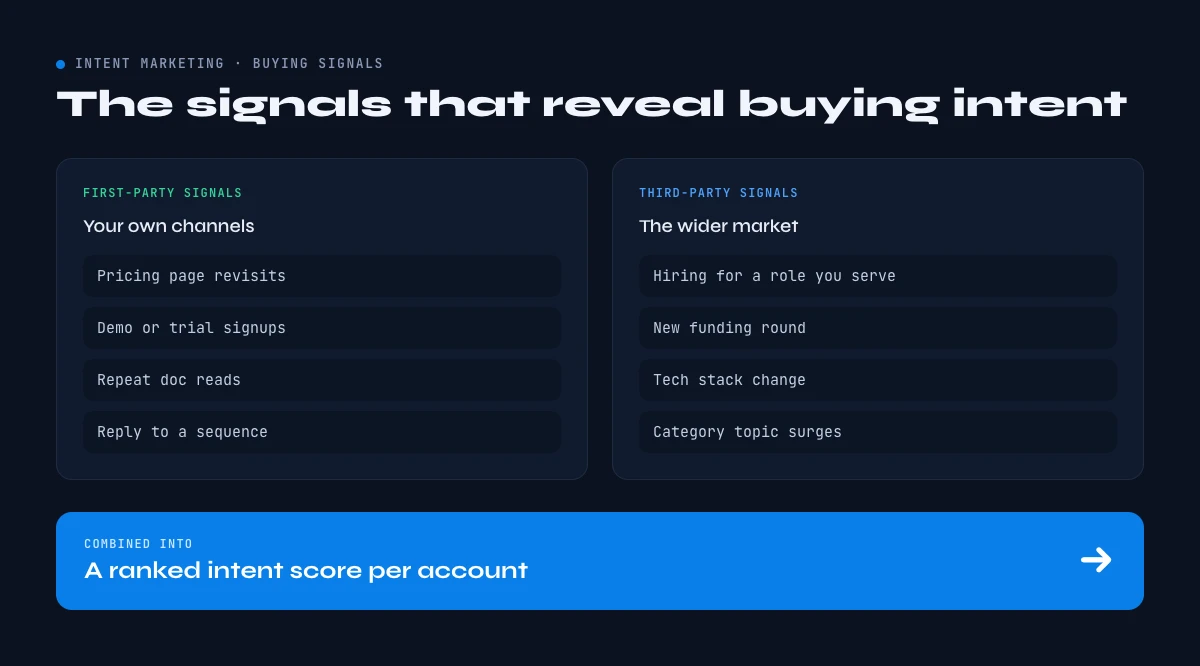
Intent shows up as signals, which fall into two broad groups.
- First-party signals are interactions with you: website visits, content downloads, pricing-page views, email replies, demo requests. They are the strongest because they come straight from the prospect.
- Third-party signals happen away from your site: research activity across the web, review-site visits, or public events that suggest a company is entering your category.
In B2B, some of the most reliable signals are concrete company events you can detect from an enriched lead list:
- Fundraising. A company that just raised is often hiring and buying to fuel growth.
- Job changes. A new decision-maker in a relevant role frequently re-evaluates tools in their first months.
- Hiring activity. Open roles reveal where a company is investing.
- Work anniversaries. A useful, low-pressure reason to reach a hard-to-access contact.
- Technology adoption. Adopting a complementary tool can signal readiness for yours.
Each of these is detectable at scale when your prospect data is enriched and current, which is what turns a raw list into a set of timed, relevant moments to act on.
The signals do not behave the same way once you try to use them. Some tell you when to write, some tell you whether the account fits, and a few do both. The table below sorts them by what they actually give you, how quickly they go stale, and what it takes to collect them.
| Signal | What it tells you | How long it stays useful | How you collect it |
|---|---|---|---|
| Open roles in your buyer's team | Timing and fit: budget is moving to that function | While the role is open, usually weeks | Careers pages and job boards, or the Company Hiring Signal at 1 credit per company |
| Funding round | Timing: fresh budget, every vendor knows the same morning | A few weeks | Public announcements and news |
| New decision-maker | Timing: the first ninety days are when tools get reviewed | About one quarter | Profile changes on the people you already track |
| New technology on the website | Fit: the stack your product plugs into is in place | Months | Website Technologies, 2 credits per site on paid plans |
| Pricing or comparison page visits | Timing, strongest of all: they are evaluating now | Days | Your own analytics, resolved to a company |
| Headcount growth | Fit: the account is growing into your segment | Months | Company enrichment, refreshed each quarter |
A full list of the signals you can see on a cold account, with what each one costs, is in our guide to B2B buying signals that work before first contact.
Score the signals you already have
Pick the signals you can genuinely see on your target accounts today, and the tool tells you what that combination supports for your intent-based marketing and what it does not.
Buying signal stack scorer
Select every signal you can currently resolve for a cold account. The verdict is about what the stack can carry, not a number out of ten.
Select the signals you can actually resolve today.
Multi-select: click a signal again to remove it. The verdict reflects two properties of a stack, its timing and its qualification, because a stack can be strong on one and empty on the other.
How to do intent marketing: a B2B workflow
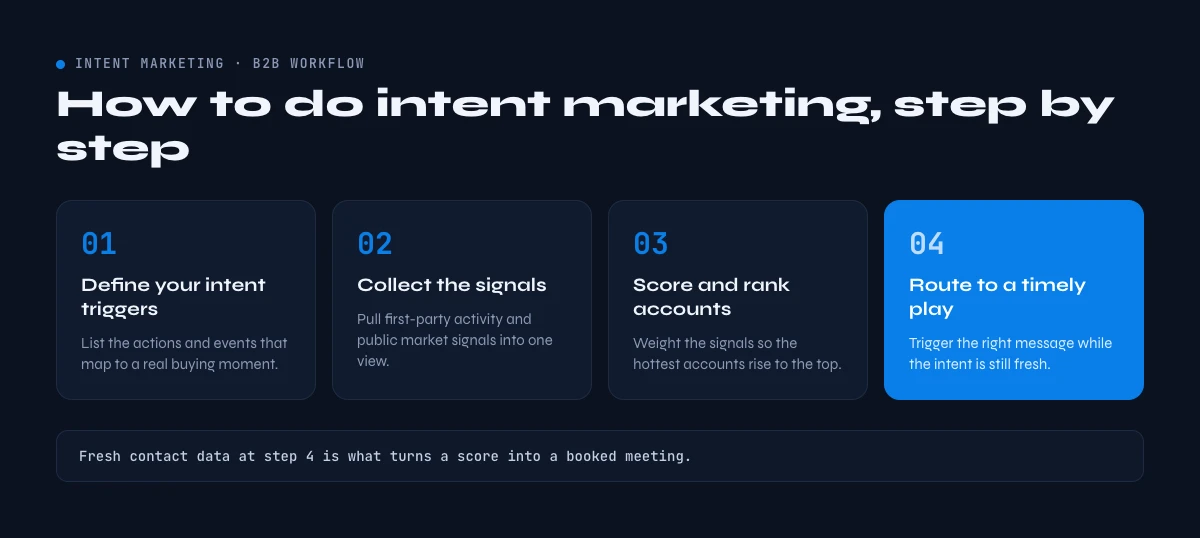
The practical loop is the same whatever signal you use:
- Detect the signal. Identify the trigger (a funding round, a job change) across your target accounts.
- Segment. Group prospects who share the signal so the message fits the moment, not just the persona.
- Enrich. Fill in the missing data (verified email, direct phone, role, company details) so you can actually reach the right person.
- Personalise. Open on the moment, not a generic pitch, so the outreach earns attention.
- Reach at the right time. Act while the signal is fresh; intent decays quickly.
The enrichment step is where most teams stall, because a list of names with a signal but no verified contact details cannot be actioned. This is where Derrick fits: from its web app or a Google Sheets sidebar you enrich a signal-matched list with verified emails, phone numbers, and company data, refreshed at lookup time, so a column of triggers becomes a column of people you can actually contact. You start from your prospect list, point Derrick at it, and it fills the data row by row, no manual research per lead.
The hard part of the loop is the jump from the account to the person. A signal almost always arrives at company level: this company is hiring, this company raised, this company added a tool. Nobody replies to a company. Between the signal and the message you need two more steps: the Import Leads from Target Companies step, which pulls the people in the relevant function at each flagged account (1 credit per lead, with your LinkedIn account connected through the Derrick Chrome extension), and a contact step, where the Email Finder returns a work email and charges 5 credits only when it finds one. That is the bridge most intent-based marketing programs never build, and it is why their signals pile up in a dashboard instead of turning into conversations.
Why timing decides intent-based marketing
A signal is only worth something while you are among the first to act on it. Once every vendor has seen it, it stops being a reason to write and becomes a reason to be ignored.
Think about what happens the day a company announces a funding round. The announcement is public. Every sales team that watches funding news sees it the same morning, and by the end of the week the new budget owner has a full inbox of messages that all open with "Congrats on the raise". The signal was real, but the advantage it gave lasted a few days. The same logic applies to every public signal: the information is free, so the edge comes only from acting faster and more relevantly than the others who saw it.
That gives you a simple way to think about the gap between detection and action. It has three parts:
- Detection delay: the time between the event and the moment it lands in your list. A pricing-page visit lands in seconds; a topic score refreshed once a week lands days after the research happened.
- Preparation delay: the time it takes to find the right person at the account and a working way to reach them. This is where most teams lose a week, because the signal arrives without a contact.
- Response delay: the time between a ready contact and a sent message. With a prepared template per signal, this should be the shortest of the three.
Shrinking the preparation delay is usually the biggest win, and it is the one most guides skip. If the people and contact details for every flagged account are filled in the same day the signal appears, intent-based marketing stops being a batch you run once a week and becomes a daily habit.
| Signal | First action | Working window |
|---|---|---|
| Pricing or comparison page visit | Personal follow-up from the account owner, referring to the problem rather than the visit | Same or next business day |
| Funding round | Message tied to what the new budget usually buys first in your category | First week, before the inbox fills |
| New decision-maker | Message tied to their first-quarter priorities | Weeks 2 to 8 of the new role |
| Open role in your buyer's team | Message about what the new hire will need on day one | While the role is open |
| New technology adopted | Message about how your product works with that stack | The first months after adoption |
These windows are working rules of thumb, not measured averages: test them against your own replies and move them when your data says so. If you want to go further on the question of when to send once a signal fires, read our guide to timing in B2B prospecting.
In the web app or Google Sheets
Start intent with a signal you own
Intent marketing usually begins with a purchased feed. It can also begin with your own account list: Derrick checks each company for open roles from your list, which gives you a timing signal you can explain to a prospect.
- Feature
- Company Hiring Signal (LinkedIn Jobs)
- Credit cost
- 1 credit per company checked
The first button opens the web app (nothing to install): 1 credit per company checked, 100 free credits every month. The second details the feature and its cost per plan.
Intent-based marketing examples: three accounts, three signals
The three examples below turn buying signals into campaigns and follow the same pattern so you can copy them: the signal, the list, the people, the message, the timing, and what to measure. Swap the signal for one you can see in your market and keep the structure.
Example 1: a funding round
Say a start-up has just announced a funding round. It is reasonable to expect an active recruitment and investment phase, because the company has fresh capital to accelerate growth. If you sell recruitment software or headhunting services, that funding announcement is your moment: the need (hiring) and the trigger (new money) line up.
The workflow in practice: you build a list of recently funded companies in your target segment, enrich each with the relevant decision-maker and their verified contact details, and reach out referencing the raise and what it usually means for hiring. Compare that to a cold blast to the same companies with no timing and no personalisation. The first feels like relevant help; the second feels like spam. Same companies, opposite reception, and the only difference is intent.
For account-level signals, see how this connects to the B2B buying committee and the broader state of B2B intent data.
Example 2: a new decision-maker
A second example shows the same logic with a different trigger. A prospect changes jobs and becomes, say, the new Head of RevOps at a target account. In their first ninety days they audit the stack and look for quick wins, which is exactly when a relevant tool gets a hearing it would never get from a settled-in buyer. Detect the job change, enrich the new contact with a verified email and direct line, and reach out with a message built around their first-quarter priorities. The trigger is different from a funding round, but the pattern is identical: a moment, the right person, accurate data, and a message that fits the moment rather than your quota.
Example 3: hiring in the buyer's team, checked against the stack
The third example combines a timing signal with a fit signal, which is where intent-based marketing gets most reliable. Suppose you sell a tool that sales teams use alongside their CRM. Start from your list of target accounts and run the hiring signal on it: for each company, does it have open sales roles right now? A company hiring three account executives is about to grow the team that would use your product, and it has budget moving to that function.
Timing alone is not enough, so check fit next. On paid plans, run the technology lookup on the shortlisted websites and keep the accounts that already run a CRM your product connects to. You now have a shortlist that is both timely (they are hiring) and qualified (the stack is in place). Pull the head of sales and the sales operations lead at each account, find their work emails, and write one message about what a growing team needs in its first month. The line that opens it is about their hiring, not about you.
The cost of building that list is easy to estimate before you start: 1 credit per company for the hiring check, 2 credits per website for the technology check, 1 credit per lead imported, and 5 credits for each email found. A test on a short list of accounts fits inside the 100 free credits a month for the hiring part; the technology and email steps need a paid plan.
What to measure in each example
Measure each example as its own campaign. Count how many accounts showed the signal, how many you reached inside the working window, how many replied, and how many turned into a meeting or an opportunity. Then compare with a control list of similar accounts that showed no signal, reached with your usual message. That comparison, repeated for a few cycles, is what tells you which signals deserve a place in your playbook.
Why intent marketing works (and how to measure it)
Intent-based marketing works because it aligns your outreach with the prospect's reality instead of your quota. Reaching someone when their need is live lifts reply and meeting rates, shortens cycles, and protects your sender reputation, since relevant messages get fewer spam complaints than generic blasts.
Measure it by comparing intent-triggered outreach against your baseline: reply rate, meeting-booked rate, and conversion to pipeline on signal-based campaigns versus untargeted ones. Track which signals produce the best response, then double down on those. The goal is not more volume; it is better timing, and the metrics should reward relevance, not raw send count.
It also helps to separate the signal from the outcome when you report. A leading indicator is how many target accounts showed a usable signal and how many you reached in time; a lagging indicator is the pipeline and revenue those touches produced. Watching both stops two failure modes: a program that detects plenty of signals but acts on none, and one that acts fast but on signals that never convert. Over a few cycles, the pattern of which signals reliably lead to meetings becomes your playbook, and you can quietly drop the triggers that look interesting but never turn into pipeline.
Two measures are worth setting up from day one. The first is influenced pipeline: the share of new opportunities where the account showed a signal before the first meeting. It tells you whether intent-based marketing is feeding the pipeline at all. The second is conversion by signal level: split your accounts into those with no signal, one signal, and two or more independent signals, and compare reply and meeting rates across the three groups. If the groups with more signals do not convert better, your signals are not measuring intent, and adding more of them will not help. Keep the method simple enough that you can rerun it every month in a spreadsheet; a measure nobody updates is worse than none.
Intent-based marketing vs ABM: how they fit together
ABM decides which accounts you focus on. Intent-based marketing decides when to engage each of them and with what message. They are not rivals: intent is the timing layer of ABM.
Account-based marketing starts from a fixed list of target accounts, chosen for fit, and coordinates sales and marketing around them. Its weak point is timing: a list of two hundred named accounts tells you who matters, not which twenty are ready this month. Intent-based marketing fills that gap by ranking the list by signal, so the team spends its effort on the accounts showing movement and keeps a lighter touch on the rest.
The difference also shows in where each starts. ABM can run with no signal at all, on fit alone. Intent-based marketing can run without a named account list, by watching a whole segment for signals and acting on whoever lights up. Most mature B2B teams end up combining them: a fit-based account list, re-ranked by intent at the start of each week. The full method for building the account list is in our guide to account-based marketing.
Intent-based targeting on ads
Intent-based targeting applies the same idea to paid media. Instead of showing ads to everyone with a given job title, you upload the accounts that show a signal and let the ad platform reach people at those companies. It works best as a warm-up before outreach: the account sees your name for a week, then gets a personal message. Keep the audience small and fresh. An audience built on signals from three months ago is just a list with a fancier name, and ad platforms need a minimum audience size, so very narrow intent lists may need to be grouped by signal type rather than run account by account.
The app works through your list row by row: 1 credit per company checked.
Common intent marketing mistakes
- Acting too late. Intent decays fast; a funding signal worked two months later has lost most of its edge.
- Signal without enrichment. Knowing a company is in-market is useless if you cannot reach the right person with verified contact data.
- Generic personalisation. Referencing the signal in name only, then pitching generically, defeats the purpose.
- One signal for everything. Different triggers fit different offers; match the signal to a genuinely relevant message.
- Chasing volume over timing. Intent-based marketing is about reaching fewer people at better moments, not sending more.
- Telling the prospect how you know. "I saw you visited our pricing page" makes people feel watched. Write about the problem the signal points to, not about the signal.
First-party versus third-party intent data
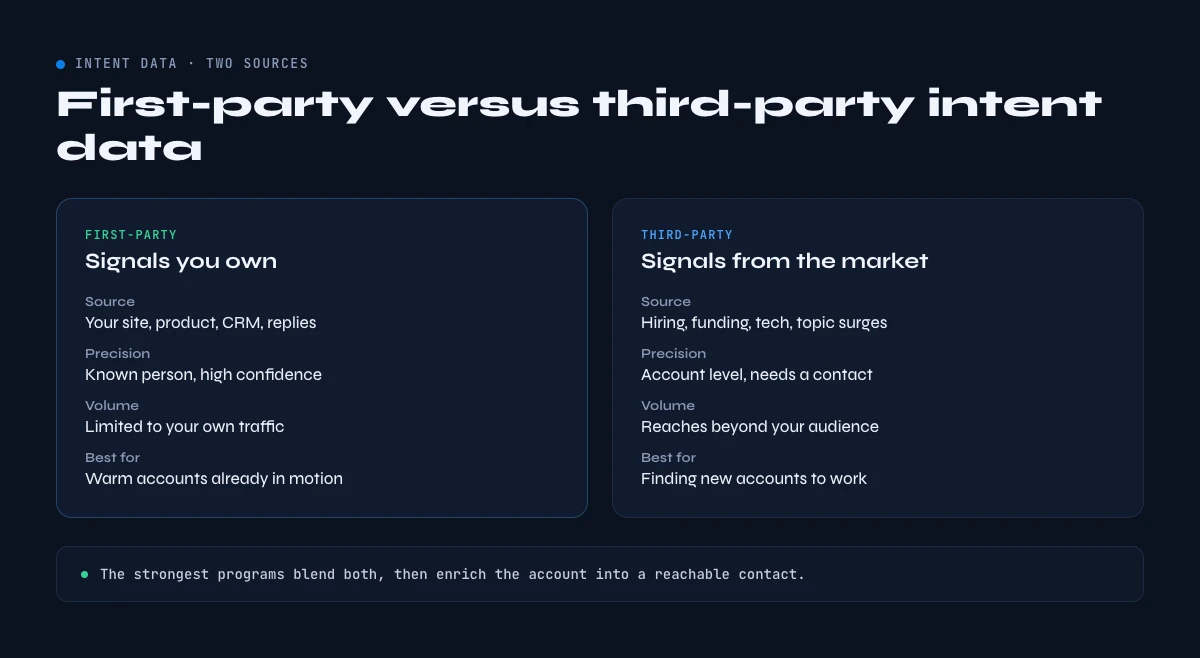
The two kinds of intent signal behave differently, and knowing which you are working with changes how you act. First-party intent comes from your own properties: someone visits your pricing page, opens three emails in a week, downloads a comparison guide, or starts a trial. It is the highest-confidence signal because the person is interacting with you directly, and it is fully yours to use. The downside is reach: first-party intent only covers people who already found you, so it misses accounts that are in-market but have never visited.
Third-party intent fills that gap. It infers interest from activity across the wider web, for example a company researching your category on review sites or publishing content about a problem you solve. It widens the net to accounts that do not yet know you, but it is noisier and lower-confidence, because the signal is inferred rather than observed. The strongest programs combine the two: third-party signals to discover in-market accounts you would otherwise miss, first-party signals to prioritise the ones already engaging with you. In both cases the signal is only the trigger. You still have to enrich the account with the right contact and reach out, which is the step that converts a data point into a conversation.
Intent marketing versus spray-and-pray outbound
Traditional outbound often works on volume: build the biggest list possible, send the same message to everyone, and accept a tiny response rate. Intent-based marketing inverts that. It sends fewer messages, to people whose need is live, with copy built around the moment rather than a generic pitch. The volume goes down; the relevance, and the response, goes up.
The difference matters beyond reply rates. High-volume, low-relevance sending damages your sender reputation, burns through your list, and trains prospects to ignore you. Mailbox providers increasingly penalise senders with high complaint and bounce rates, so spray-and-pray is not just less effective, it is actively risky. Intent-based outreach protects the channel: relevant messages to engaged, well-targeted contacts earn fewer complaints and keep deliverability healthy. The trade-off is effort. Intent-based marketing asks you to detect a signal, enrich the list, and personalise, which is more work per contact than blasting. But the work pays back in reply rate, pipeline quality, and a channel that keeps working instead of degrading. For most B2B teams in 2026, with inboxes more crowded and filters stricter than ever, that trade is firmly worth making.
Where intent-based marketing breaks down
Intent-based marketing fails in predictable places: signals that look like intent but are not, signals that point to a company but not to a person, and data collected in ways your legal team would not sign off.
False positives. Not all buying signals mean someone is buying. A company reading about your category may be a student, a journalist, a competitor or a vendor doing its own research. A pricing-page visit may come from your own customer checking an invoice. An open sales role may be a replacement, not growth. The fix is not a better score; it is a second, independent signal before you treat the account as warm. One signal makes an account worth watching. Two signals that point the same way make it worth a message.
Company, not person. Most intent data resolves to a company, never to the individual who did the research. In a buying group of several people, the one reading about your category may not be the one who signs. That is why the account-to-person step matters so much: you need to reach the people in the function the signal points to, and you need more than one of them. Our buying committee report covers how many contacts that usually takes.
Compliance. Some third-party intent data is built from tracking people across sites they never connected to you. Ask any provider how the data is collected and on what legal basis, and prefer signals that are public by nature (a published job opening, an announced funding round, technology visible on a public website) or that come from your own channels with consent. Contacting someone because of a public company event is easy to explain. Contacting them because of a cookie they never noticed is not.
Everyone sees the same thing. The most popular public signals are watched by every vendor in your market. If your only edge is the signal, you have no edge. The difference comes from combining signals others do not combine, and from the quality of the message once you write it.
Keeping intent data accurate
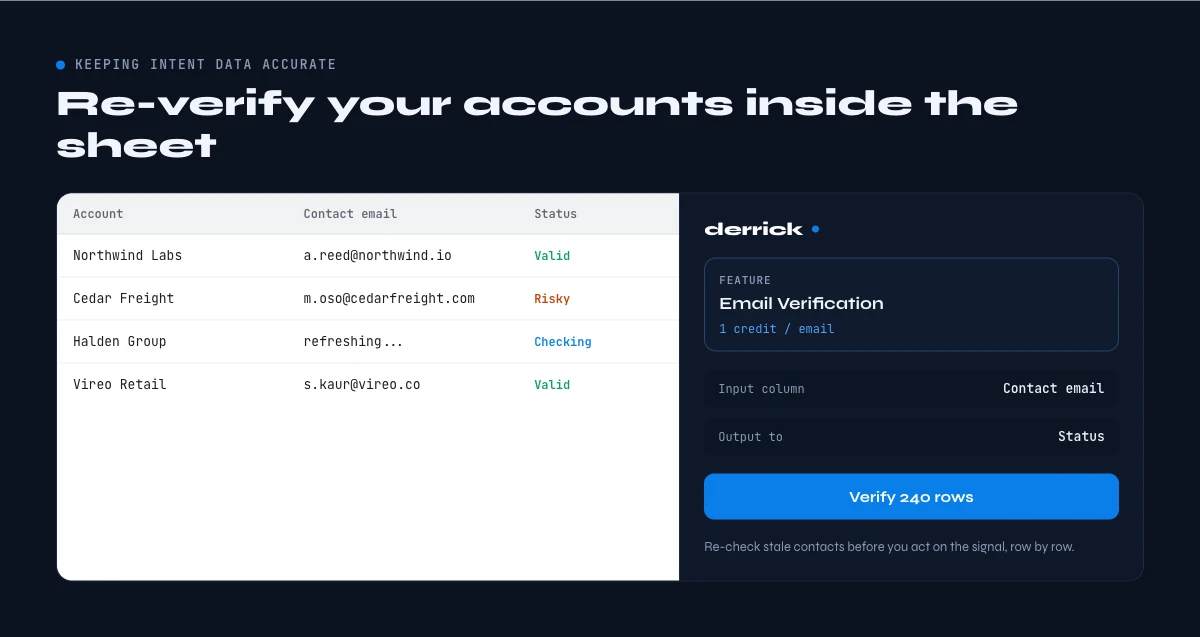
Intent marketing depends on data that is both timely and correct, and B2B data decays fast. People change jobs, companies merge, phone numbers and emails go stale, so a signal-matched list built last quarter is partly wrong today. Acting on a great signal with an outdated contact wastes the moment: the email bounces, the call reaches a number that has moved on, and the timing advantage is lost.
That is why enrichment for intent marketing is not a one-time export but an ongoing habit. The practical pattern is to enrich the list at the moment you act on the signal, rather than relying on data captured weeks earlier, so the contact details are as fresh as the trigger. Verifying emails and direct phones before you send keeps bounce rates low, which protects the sender reputation that intent marketing is supposed to safeguard. Live, verified data and timely signals are two halves of the same discipline: the signal tells you when, and accurate enrichment makes sure you can actually reach the right person when that moment arrives.
AI and intent-based marketing in 2026
AI has changed the cost of the slow steps in intent-based marketing: reading signals, researching accounts and drafting the first message. It has not changed the need for accurate data underneath.
Three uses are worth adopting now. The first is summarising signals: instead of a sales rep reading a careers page, a news item and a company profile, an AI assistant turns them into two lines on why this account, why now. The second is asking questions in plain language. With Derrick connected to Claude through MCP (Plus plans and above), you can ask "which of my target accounts are hiring a head of sales right now?" and get an answer built from live data rather than from what the model remembers. The third is drafting the first message from the signal, the role and the account context, which a person then edits before sending.
Two cautions keep this honest. A language model does not know who is hiring today; anything it says about a specific company without a live data source is a guess, and guesses sent at scale damage your reputation faster than generic messages. And AI does not fix a weak signal. If the input is a vague topic score, the output is a well-written message to an account that was never in-market. Put the data first, then let AI speed up what you do with it.
Getting started with intent-based marketing
You do not need an enterprise budget to start. Pick one signal you can detect reliably (a funding round, a job change, a work anniversary), build a small list of accounts showing it, enrich that list with verified contacts, and run a focused, personalised campaign timed to the signal. Measure the response against your usual outreach, then expand to the signals that worked.
Intent-based marketing is something most teams already do intuitively when they notice a trigger and reach out. Formalising it, detecting signals deliberately, enriching the list, and acting while the moment is fresh, is what turns an occasional good instinct into a repeatable engine. To go deeper on the data behind it, browse the B2B intent data hub and the guide to product ratings as a buying signal.
A first month can look like this. Week one: list your target accounts and run the hiring signal on them in the Derrick web app. Week two: shortlist the accounts with open roles in your buyer's team, import the people in that function and find their emails. Week three: send one message per account, written around the signal, within the working window. Week four: compare replies against a control list and decide which signal to keep. The same steps run in Google Sheets if your campaigns live in a spreadsheet, in Claude through MCP if you prefer to ask in plain language, and through the API if you want the signal to land straight in your CRM (MCP and API are available from the Plus plan).
From a warm account to the right person, in time
The most useful lesson from teams that make intent-based marketing work is that they start small and close to home. Their own pricing-page visits and replies, plus a handful of public company events, are enough to run the whole loop: detect, shortlist, find the people, write, measure. Paid intent platforms can come later, once you know which signals turn into meetings for you and what you would want more of.
What separates a working program from a dashboard full of signals is the last step: getting from a warm account to a named person with a working email, inside the window. That is the step Derrick covers, in the web app, in Google Sheets, in Claude through MCP or through the API. Try Derrick free with 100 credits a month and run your first signal on a short list this week.
Frequently asked questions
What is intent-based marketing?
What are intent signals?
What is the difference between intent marketing and intent data?
How do you start with intent marketing on a small budget?
Why does intent marketing improve reply rates?
Do I need third-party intent data to start intent-based marketing?
Is intent-based marketing the same as ABM?
What is the difference between intent data and buying signals?
Keep reading
Continue exploring this cluster


Product Rating Checker: How to Identify Your Prospects' Tech Stack via Reviews
Read →

How to Score, Segment, and Personalize Your Outreach Using G2 Insights
Read →

Product Review Finder: How to Mine Reviews for B2B Prospecting Intent
Read →

Third Party Intent Data Sources: The Six Families, Compared
Read →