




B2B data glossary 682 terms

The Ultimate Data Enrichment Glossary: 682+ Key Terms Explained

This glossary is your go-to reference for understanding the core concepts of data enrichment. Whether you're working in marketing, sales, customer success, or data engineering, this curated list of 682+ terms covers everything from API-based enrichment to real-time data scoring.

Try the app free
or use it in
Google Sheets
Claude
API
4.6 / 5 on Google Workspace Marketplace4.5 / 5 on G2254 upvotes on Product Hunt
Part 1 / 3

Browse A-Z

All 682 terms, A to Z

Search by name, filter by topic, or jump to a letter. Every definition opens on its own page with an example and related terms.

C

C Level Or C Suite Call Analytics Call Disposition Call For Proposal Canary Releases Ccpa Compliance Cdp Challenger Sales Challenger Sales Model Champion Challenger Test Channel Marketing Channel Partner Channel Partners Channel Sales Chatbots Churn Ci Cd Click Through Rate Clickfunnels Closed Lost Closed Opportunities Closed Question Closed Won Closing Ratio Cloud Based Crm Cloud Storage Clustering Cohort Analysis Cold Call Cold Calling Guide Cold Email Guide Cold Emailing Commission Guide Competitive Advantage Competitive Analysis Competitive Intelligence Competitive Landscape Complex Sale Compliance Testing Compounded Annual Growth Rate Consideration Buying Stage Consultative Sales Consultative Selling Guide Consumer Consumer Buying Behavior Contact Data Contact Discovery Content Curation Content Delivery Network Content Management System Content Rights Management Content Syndication Contract Management Conversational Intelligence Conversion Path Conversion Rate Copyright Compliance Corporate Identity Cost Per Click Cost Per Impression Cpm Cpq Software Crm Analytics Crm Data Crm Enrichment Crm Integration Cross Selling Cross Site Scripting Css Custom Api Integration Custom Metadata Types Customer Acquisition Cost Customer Buying Signals Customer Centricity Customer Churn Rate Customer Data Analysis Customer Data Management Customer Data Platform Customer Engagement Customer Experience Customer Journey Mapping Customer Lifecycle Customer Lifetime Value Customer Loyalty Customer Relationship Management Hygiene Customer Relationship Management Systems Customer Relationship Marketing Customer Retention Customer Retention Cost Customer Retention Rate Customer Segmentation Customer Success Cybersecurity

S

Sales Acceleration Sales And Marketing Alignment Sales And Marketing Analytics Sales Automation Guide Sales Bundle Sales Calls Sales Champion Sales Coach Sales Coaching Sales Compensation Sales Conversion Rate Sales Cycle Guide Sales Dashboard Sales Demo Sales Demonstration Sales Development Sales Development Representative Guide Sales Dialer Sales Director Sales Enablement Guide Sales Enablement Content Sales Enablement Platform Sales Enablement Technology Sales Engagement Sales Engineer Sales Forecast Sales Forecast Accuracy Sales Funnel Guide Sales Funnel Metrics Sales Intelligence Sales Intelligence Platform Sales Key Performance Indicators Sales Kickoff Sales Lead Sales Manager Sales Methodology Sales Metrics Sales Objections Sales Operations Sales Operations Analytics Sales Operations Key Performance Indicators Sales Operations Management Sales Partnerships Sales Performance Management Sales Performance Metrics Sales Pipeline Guide Sales Pipeline Management Sales Pipeline Reporting Sales Pipeline Velocity Sales Pipeline Velocity Formula Sales Pitch Sales Plan Template Sales Playbook Sales Presentation Sales Process Guide Sales Productivity Sales Prospecting Sales Prospecting Software Sales Prospecting Techniques Sales Qualified Lead Sales Quota Guide Sales Rep Training Sales Script Sales Sequence Sales Stack Sales Strategy Sales Team Management Sales Territory Guide Sales Territory Management Sales Territory Planning Sales Training Sales Velocity Sales Workflows Salesforce Administrator Salesforce Object Query Language Sandboxes Scalability Scrum Sdk Search Engine Results Page Segmentation Analysis Self Service Saas Model Sem Sender Policy Framework Sentiment Analysis Seo Serverless Computing Service Level Agreement Serviceable Available Market Serviceable Obtainable Market Sfdc Shipping Solutions Signaling Siloed Simple Object Access Protocol Application Programming Interface Single Page Applications Single Sign On Single Source of Truth Guide Site Retargeting Small To Medium Sized Business Smarketing Smile And Dial Social Proof Social Selling Soft Sell Software As A Service Software Asset Management Solution Selling Spiff Spin Selling Sql Stakeholder Statement Of Work Stress Testing Subject Matter Expert Subscription Models Supply Chain Management System Of Record
Part 2 / 3

In-depth guides

39 terms explained in depth

Long-form entries: how the concept works, real examples, why it matters and the common mistakes.

Account Based Marketing Account-based marketing (ABM) is a B2B strategy that focuses sales and marketing on a defined set of high-value target accounts, treating each account as a market of one. Instead of casting a wide net for leads, ABM coordinates personalised outreach across channels to win and grow specific named accounts. What Is B2B Sales? Meaning, Types, Roles and How It Works What is B2B sales? B2B sales (business-to-business sales) is the process of selling products or services from one business to another, rather than to individual consumers. B2B deals typically involve multiple stakeholders, longer sales cycles, higher prices, and a more consultative, relationship-driven approach than consumer (B2C) sales. In one line, the B2B sales meaning comes down to who buys: a company, usually through several people. Ballpark Meaning in Business: What a Ballpark Estimate Is and How to Use It In business, a ballpark is a rough, non-binding estimate of a price, budget or timeline, usually given as a range before the detailed work is done. It answers one question fast: are we in the same zone? A useful ballpark states a range, the basis behind it and what could move it, so both sides can decide whether to go further. What Is Cold Calling? Cold calling is a sales technique where a rep phones a prospect who has had no prior contact with the company and has not asked to be called. The goal of a cold call is rarely to sell on the spot. It is to start a conversation, qualify the need and book a next step, usually a meeting or a demo. What Is a Cold Email? What is cold email? A cold email is a one-to-one business email sent to someone you have never been in contact with, to start a professional conversation: a sales meeting, a partnership, a job, an interview. The cold email meaning comes from the cold start: no prior relationship. What separates it from spam is the method: one chosen person, one clear reason to write, an address that exists. What Is a Sales Commission? Types, Formulas and Examples A sales commission is the variable pay a salesperson earns on the sales they close, usually a percentage of the deal value or of the margin. Example: a 10% commission on a $20,000 deal pays $2,000. Most plans pair it with a base salary, and the commission structure decides how the rate changes as the rep sells more. What Is Consultative Selling? Definition, 7 Steps and Examples Consultative selling is a sales approach where the rep acts as an advisor, not a presenter. The rep prepares the account, asks open questions, diagnoses the buyer's real problem with them and recommends only what solves it, even when that means a smaller deal. Trust and the quality of the diagnosis win the sale, not the pitch. Dynamic Data Dynamic data is information that changes frequently - contact details, company size, pricing, intent signals, job titles. In B2B sales-ops it's the opposite of static data (a person's birth year never changes; their job title might change tomorrow). Operating with dynamic data requires fresh-refresh discipline, otherwise your CRM rots in months. Email Warmup Email warmup is the process of gradually increasing the volume of messages sent from a new email address or domain, so mailbox providers learn to trust it. A warmed inbox builds sender reputation over a few weeks, which helps cold and marketing emails land in the inbox instead of the spam folder. End of Day (EOD): Meaning at Work, EOD vs COB and What Time EOD stands for end of day: the close of the recipient's working day, usually 5 PM local time. COB (close of business) means almost the same thing, the end of business hours, while EOD is sometimes read more loosely as "before I log off". In sales and customer emails, add the hour and the time zone to avoid confusion. Gross Sales vs Net Sales Gross sales is the total value of all sales before any deductions, while net sales is what remains after subtracting returns, discounts, and allowances. Net sales is the more accurate picture of real revenue, which is why it sits at the top of most income statements. High Ticket Sales High ticket sales is the practice of selling high-value products or services, usually from several thousand to hundreds of thousands of dollars per deal. It depends on consultative selling, a longer sales cycle, and trust built with a small set of high-intent buyers, rather than on a high volume of low-priced transactions. What Is a Hot Lead? Meaning, Signs and How to Find Hot Leads A hot lead is a prospect who has shown explicit buying intent recently and fits your ideal customer profile: they asked for a demo, questioned your pricing or replied with a real need. The window is short, hours to a few days, and the signal that made them hot should be the first line of your reply. Ideal Customer Profile An ideal customer profile (ICP) is a description of the type of company that gets the most value from your product and is the most profitable for you to serve. It is built from firmographic, technographic, and behavioural traits of your best existing customers, and it focuses sales and marketing on the accounts most likely to convert and stay. Lead Scoring Lead scoring is a method of ranking leads by how likely they are to become customers, by assigning points for fit (how well they match your ideal customer profile) and engagement (how they interact with you). The score tells sales which leads to call first and when marketing should hand a lead over. What Is a Marketing Qualified Lead (MQL)? A marketing qualified lead (MQL) is a lead that marketing judges ready for a first sales conversation, because it meets two agreed conditions: the person fits the type of buyer you sell to, and they have engaged enough with your content to show real interest. The MQL meaning is a handoff point, not a quality label: once a lead crosses the threshold, it goes to sales, who then confirm it as a sales qualified lead or send it back. Mobile Compatibility Mobile compatibility means a B2B sales tool functions properly on a phone or tablet - not just renders without breaking. The bar is higher than "responsive design": data entry must work, key actions must be one-tap, performance must hold on 4G. Most enterprise sales tools fail at least one of those tests. What Is Net New Business? Meaning, Formula and How to Track It Net new business means revenue from customers who have never bought from you before, closed within a given period. It leaves out upsells, expansion, renewals and returning customers, so it shows what your acquisition motion alone produced. The formula: total new bookings minus expansion, renewals and reactivations. What Is OTE? On-Target Earnings Meaning in Sales, With Examples What is OTE? OTE stands for on-target earnings: the total pay a sales rep earns in a year when they hit 100% of quota. It adds a fixed base salary to variable pay, usually commission or a bonus. OTE is a target, not a promise. Miss quota and you take home less. Beat it, and accelerators can lift your pay above the OTE. Outside Sales Outside sales, also called field sales, is selling that happens through in-person meetings rather than remotely. Outside reps travel to meet prospects and customers face to face, at their offices, at events, or on site. It contrasts with inside sales, which is run remotely by phone, email, and video. Point of Contact (POC): Meaning, Responsibilities and Examples A point of contact (POC) is the person designated to handle communication about a specific topic, project or relationship, so everyone knows who to reach. A project, a supplier, a support account or an HR process can each have one. In B2B sales, an account usually has several: a buying POC, a technical POC, a champion and a renewal POC. Product Champion A product champion is an internal advocate at a prospective buying account who actively pushes for your product. They're not the budget owner and rarely the technical evaluator - they're the loudest voice in internal meetings, the person who writes the business case, the one who Slacks colleagues at 11 PM about the demo. Without a champion, complex B2B deals stall. What Is Prospecting? Meaning, Methods and the Steps Reps Follow What is prospecting? Prospecting is the work of finding potential customers and starting a first conversation with them, so that some of them become sales opportunities. In plain terms, the prospecting meaning is simple: you look for people who could buy, check that they fit, and reach out first. It happens before any deal exists, which is why it sits at the very start of the sales pipeline. Return on Sales Return on sales (ROS) is a profitability ratio that shows how much operating profit a company earns from each dollar of revenue. The formula is operating profit divided by net sales, expressed as a percentage. A higher ROS means the business converts more of its revenue into profit. Sales Automation Sales automation is the use of software to handle repetitive, manual sales tasks, such as data entry, follow-up sequences, lead routing, and data enrichment, so reps spend more time actually selling. It removes busywork from the sales process rather than replacing the human judgement that closes deals. What Is the Sales Cycle? 7 Stages Explained The sales cycle is the series of stages a deal moves through, from the first contact with a prospect to the signed contract and the follow-up after it. Most models count seven stages: prospecting, making contact, qualifying, presenting, handling objections, closing and follow-up. Its length is the average number of days between first contact and a won deal. SDR Meaning in Sales: What a Sales Development Representative Does SDR means sales development representative. An SDR is the rep who works the top of the B2B funnel: researching accounts, reaching out to cold and inbound leads, and qualifying them before handing the strongest ones to an account executive who closes. SDRs are judged on meetings booked and qualified pipeline created, not on closed revenue. Sales Enablement Sales enablement is the strategic process of equipping sales reps with the content, training, tools, and data they need to sell more effectively. It aims to shorten ramp time, make the team's messaging consistent, and lift win rates by giving reps the right resource at the right moment in a deal. Sales Funnel A sales funnel is a model of the journey a prospect takes from first awareness of your product to becoming a customer, drawn as a funnel because the number of people narrows at each stage. It maps stages such as awareness, interest, consideration, intent, and purchase, so teams can see where prospects drop off and where to focus. Sales Pipeline A sales pipeline is a visual representation of where every active deal sits in your sales process, from first contact to closed. Each stage reflects a step a prospect takes toward buying, so the pipeline shows how much potential revenue exists and how likely it is to close. Sales Process A sales process is the repeatable set of steps a sales team follows to move a prospect from first contact to a closed deal. A clear process makes selling consistent and scalable: every rep knows what happens at each stage, what moves a deal forward, and what good looks like, rather than improvising each time. What Is a Sales Quota? Definition, Types and How to Set One A sales quota is the revenue, deal count, activity or margin a rep or team must reach in a set period, and it drives their variable pay. Managers set a sales quota top-down from the company goal, bottom-up from what each territory can produce, or both, and track it as quota attainment: closed results divided by quota. What Is a Sales Territory? Definition and Types What is a sales territory? A sales territory is the set of customers and prospects that one sales rep or one sales team is responsible for. It can be drawn by geography, industry, company size, product line or a list of named accounts. Each account has a single owner, so nobody prospects the same company twice, every segment of the market has someone covering it, and quotas can be set against a fair share of potential. Single Source of Truth A single source of truth (SSOT) is one authoritative, consistent data store that every team and system references, so there is no conflict between versions. In B2B it usually centres on the CRM, with customer, account, and contact data kept clean and synchronised so sales, marketing, and finance all work from the same numbers. Total Addressable Market Total addressable market (TAM) is the total revenue opportunity available for a product or service if it captured 100 percent of its market. It is the largest of three nested figures (TAM, then SAM, then SOM) and is used to size an opportunity, shape strategy, and judge how big a business could realistically become. Types of Sales Types of sales describe the main ways companies sell, grouped by who buys, how reps engage, and how complex the deal is. The most common splits are B2B vs B2C, inside vs outside sales, transactional vs consultative selling, and direct vs channel sales. Most teams blend several of these models. User Interaction User interaction is any action a user takes inside a product - clicks, scrolls, form fills, API calls, hover events. In B2B SaaS it's the raw material of product analytics, activation tracking, and feature adoption. The interactions you measure determine the product decisions you can make. Website Visitor Tracking Website visitor tracking is the collection and analysis of what people do on a website: the pages they view, where they came from, how long they stay and, in B2B, which company they work for. It runs on a tracking script or pixel, cookies and IP lookup. Teams use it to improve the site, measure campaigns and spot the accounts that show interest. X Sell X-sell (short for cross-sell) is the practice of selling a different product to a customer who already buys from you. It's distinct from upsell (selling more of the same product or a higher tier) and from renewal (resigning the same contract). X-sell is the most efficient new-revenue channel a B2B company has - typically 5-10× cheaper than acquisition.
Part 3 / 3

FAQ

Questions about the glossary

What is a data-enrichment glossary?

+

A data-enrichment glossary is a single reference for the vocabulary that B2B sales, marketing-ops, RevOps, customer-success and data-engineering teams use day to day. This Derrick glossary covers 682 terms, from API-based enrichment to real-time lead scoring, ICP to MQL, intent data to firmographics. Each entry gives a plain-English definition, an example and links to related terms.

Who uses a B2B data glossary?

+

Anyone whose work touches contact and account data: outbound SDRs picking the right enrichment provider, RevOps owning the CRM scoring model, marketing-ops segmenting audiences, customer-success teams renewing accounts. The glossary is the shared map: everyone gets the same definition of 'firmographic', 'intent', 'lead source' or 'TAM' before the meeting starts.

How is this glossary different from a generic SaaS dictionary?

+

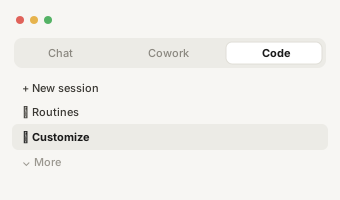
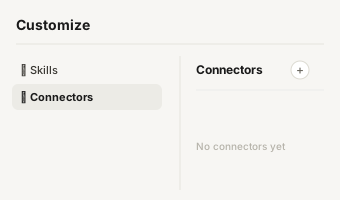
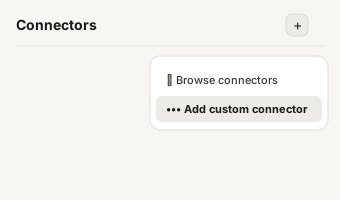
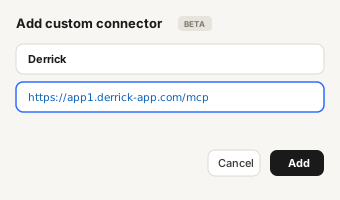
Terms are tied to the enrichment work they describe. We don't just define ICP: we link to the enrichment workflows that build and refresh an ICP list. We don't just define 'work email': we link to the feature that finds it, in the Derrick web app, in Google Sheets, in Claude (MCP) or through the API.

Is the glossary free to read?

+

Yes. All 682 entries are open-access, no paywall, no email gate. The free Derrick plan (100 credits every month, no credit card) lets you try the workflows referenced in each entry in the Derrick web app, nothing to install.

How often is the glossary updated?

+

Entries are revisited when the practice or the tooling behind a term changes. Each definition page shows the date of its last real update, so you can see how fresh it is.

How do I suggest a missing term?

+

Drop us a note via the contact form. We review every suggestion and add the terms that have real search demand and a clear link to B2B sales or data work.

Why teams choose Derrick.

Powerful features that save time and boost your sales pipeline.

ENRICHMENT

100+ data points on companies & leads.

AI POWERED

Built-in AI, no separate subscription.

FOUR SURFACES

The web app, Google Sheets, your AI assistant, or the API.

BEST VALUE

Same quality data, for a fraction of the cost.

From a search to a campaign, in one place

The four steps Derrick covers in the web app, and the features behind each one.

Customer stories

Loved by sales teams worldwide

See what our customers say about Derrick.

  • Rated 4.6 out of 5 on Trustpilot, 323 reviews
323 reviews

"This app saved me so much time and effort. Great for anyone looking to build a contact list or network at scale quickly. As a start-up it's been invaluable."

Alex Clark

Director | SaaS GTM Leader

Reviewed on Product Hunt

"Working pretty nifty compared to Snov.Io. Price wise it does give a fair shake, and IMO better interface since it's google sheets."

David Sire

Mortgage Broker at Zero Point Mortgage

Reviewed on Product Hunt

"Derrick is a very simple and user-friendly app to enrich your contacts database. Best thing: you can test it for free. And then the price is so low, it's a no brainer."

Etienne Grange

CEO Form'actions

Reviewed on Capterra
Start now. It takes a minute.

No setup, no onboarding call, nothing to migrate. Add Derrick where you already work, build a list or enrich your own, free to start.

Try the app free
or use it in
Google Sheets
Claude
API