



B2B data glossary Definition

Sales Pipeline

A sales pipeline is a visual representation of where every active deal sits in your sales process, from first contact to closed. Each stage reflects a step a prospect takes toward buying, so the pipeline shows how much potential revenue exists and how likely it is to close.

Updated
Try the app free
or use it in
Google Sheets
Claude
API
4.6 / 5 on Google Workspace Marketplace4.5 / 5 on G2254 upvotes on Product Hunt
Part 1 / 7

Definition

Definition: Sales Pipeline

Sales Pipeline: A sales pipeline is a visual representation of the stages a prospect goes through from initial contact to closing a deal.A sales pipeline is crucial for tracking and managing sales opportunities effectively. It helps sales teams visualize and evaluate the progress of potential deals, ensuring that they can allocate resources efficiently and prioritize efforts on the most promising leads. In digital marketing and sales automation, a sales pipeline is instrumental in forecasting revenue, identifying bottlenecks, and improving conversion rates by providing clear insights into the sales process. By leveraging CRM tools and data enrichment, businesses can automate and enhance their sales pipelines, leading to more accurate predictions and better decision-making. A well-managed sales pipeline not only boosts productivity but also enables teams to deliver tailored customer experiences, ultimately driving business growth.


Part 2 / 7

How it works

How Sales Pipeline works

A pipeline organises open opportunities into ordered stages. A common B2B set is:

  • Lead or prospect - identified but not yet engaged.
  • Qualified - fit, need, and timing confirmed.
  • Meeting or demo - active conversation underway.
  • Proposal - pricing and terms on the table.
  • Negotiation - working toward signature.
  • Closed won or lost - the outcome.

Each stage carries an expected probability, so multiplying deal value by stage probability gives a weighted pipeline that feeds the forecast. Managing a pipeline means moving deals forward with clear exit criteria for each stage, and keeping it clean: dead deals get closed-lost, and every opportunity carries an accurate value, owner, and next step. A pipeline full of stale or duplicate records produces a forecast no one can trust.

Part 3 / 7

Examples

Real-world examples

An account executive carries 20 open deals worth 600,000 dollars in total. Five sit at proposal (70 percent probability), ten at qualified (30 percent), and five at first meeting (10 percent). The weighted pipeline is far below the 600,000 headline, and that weighted number, not the raw total, is what the rep commits to the forecast.

A sales manager reviewing the team pipeline spots eight deals that have not moved in 45 days. Rather than let them inflate the forecast, the manager works with reps to either advance them with a concrete next step or close them lost, so the pipeline reflects reality.

Part 4 / 7

Why it matters

Why Sales Pipeline matters in 2026

The pipeline is the operating system of a sales team. It drives the forecast, shows where deals stall, and tells managers whether the team has enough coverage to hit quota. Without it, leaders are guessing.

Pipeline quality matters as much as quantity. A common benchmark is pipeline coverage of three to four times quota, but coverage built on stale or mis-qualified deals is an illusion. That is why pipeline hygiene, accurate stages, values, and contact data, is a recurring discipline rather than a one-time cleanup, and why clean CRM data underpins any forecast worth acting on.

Part 5 / 7

Tools

Sales Pipeline & Derrick: tools to operationalize

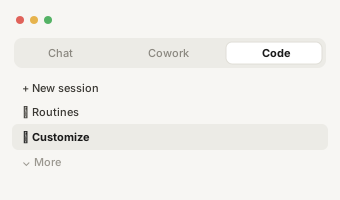
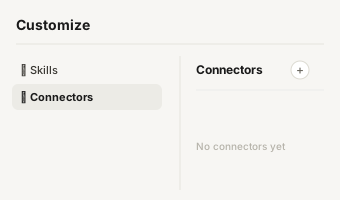
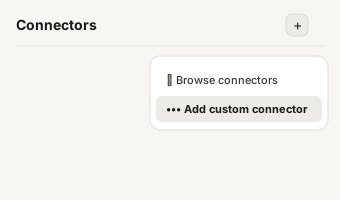
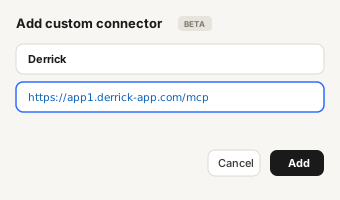
Pipeline, forecast, territory, ICP refresh: Derrick keeps the account and contact data behind them fresh. Work in the web app, or run the same enrichment from Google Sheets, Claude (MCP) or the API.

Compare sales tools →
Part 6 / 7

Common mistakes

Common mistakes

  • Letting stale deals linger. Opportunities that never move inflate the forecast and hide the real picture.
  • No exit criteria per stage. If reps advance deals on optimism rather than evidence, stages become meaningless.
  • Confusing pipeline with forecast. Total pipeline value is not what will close; the weighted, committed number is.
  • Dirty data. Duplicate records and wrong values make the whole pipeline untrustworthy.

Why teams choose Derrick.

Powerful features that save time and boost your sales pipeline.

ENRICHMENT

100+ data points on companies & leads.

AI POWERED

Built-in AI, no separate subscription.

FOUR SURFACES

The web app, Google Sheets, your AI assistant, or the API.

BEST VALUE

Same quality data, for a fraction of the cost.

From a search to a campaign, in one place

The four steps Derrick covers in the web app, and the features behind each one.

Any questions?

Stop copying data around. Start enriching.

What is the difference between a sales pipeline and a sales funnel?

+
A pipeline is the seller's view: the stages a rep moves a deal through, tracked in the CRM. A funnel is the broader view of how many prospects convert from one stage to the next, often used by marketing. The pipeline is about managing specific deals; the funnel is about conversion rates across volume.

What are the typical stages of a sales pipeline?

+
A common B2B sequence is lead, qualified, meeting or demo, proposal, negotiation, then closed won or lost. The exact stages vary by company, but each should represent a concrete step the buyer takes, with clear criteria to move forward.

What is pipeline coverage?

+
Pipeline coverage is the ratio of open pipeline value to quota. A common target is three to four times quota, on the assumption that not every deal closes. Healthy coverage built on well-qualified deals is more meaningful than a large number padded with stale opportunities.

How do you keep a sales pipeline clean?

+
Set exit criteria for each stage, review deals regularly, close out opportunities that have stalled, keep deal values and owners accurate, and maintain clean contact data so records are not duplicated or out of date. Hygiene is ongoing, not a one-off.
Start enriching LinkedIn profiles today

Open the Derrick web app, import a LinkedIn search or your own list, nothing to install. The free plan gives you 100 credits every month, no credit card.

Try the app free
or use it in
Google Sheets
Claude
API
100 credits free every month
1 credit per LinkedIn profile imported
5 credits per email found (paid plans)