



B2B data glossary Definition

What Is OTE? On-Target Earnings Meaning in Sales, With Examples

What is OTE? OTE stands for on-target earnings: the total pay a sales rep earns in a year when they hit 100% of quota. It adds a fixed base salary to variable pay, usually commission or a bonus. OTE is a target, not a promise. Miss quota and you take home less. Beat it, and accelerators can lift your pay above the OTE.

Updated
Try the app free
or use it in
Google Sheets
Claude
API
4.6 / 5 on Google Workspace Marketplace4.5 / 5 on G2254 upvotes on Product Hunt
Part 1 / 7

Definition

Definition: On Target Earnings

What is OTE?

OTE (on-target earnings) is the total yearly compensation a salesperson receives when they reach 100% of their quota. The formula is simple: base salary plus the commission or bonus paid at target. A job ad that says "$120K OTE" means $120,000 for a rep who hits the number. It is not a guaranteed salary.

What is OTE in sales?

In sales, OTE is the headline figure of the compensation plan. It tells a candidate what the role pays when the quota is met, and it tells the company what a fully productive rep costs. Two numbers sit behind it: the base salary, paid every month whatever happens, and the variable part, earned deal by deal or meeting by meeting. How that variable part is worked out is covered in our page on how sales commission is calculated.

On Target Earnings (OTE) refers to the total potential compensation an employee can earn if they achieve their performance targets, typically consisting of a base salary plus commission or bonuses. In the context of digital marketing and sales automation, OTE is a critical metric used to align employee incentives with company objectives, motivating sales teams to meet or exceed their goals. By clearly delineating how much a salesperson can earn, including both fixed and variable components, businesses can effectively manage talent and drive productivity. OTE is particularly relevant in sales roles where performance is directly linked to revenue generation. It helps organizations forecast payroll expenses more accurately and establish benchmarks for evaluating sales performance. Understanding OTE is essential for crafting competitive compensation packages that attract and retain top talent while ensuring alignment with strategic sales targets.


Part 2 / 7

How it works

How On Target Earnings works

How to calculate OTE

The OTE formula has two terms:

OTE = base salary + variable pay at 100% of quota

Take an illustrative account executive role. The numbers show the math. They are not a market benchmark.

  • Base salary: $70,000 a year, paid whatever the results.
  • Variable pay at target: $30,000, paid as commission when the rep closes the full quota.
  • Annual quota: $600,000 in new revenue.
  • Commission rate: $30,000 divided by $600,000, so 5% of every dollar closed.
  • OTE: $70,000 + $30,000 = $100,000.

The formula also runs backwards. If an offer gives you an OTE and a pay mix, multiply the OTE by each share to get the base and the variable. A $100,000 OTE on a 70/30 mix means a $70,000 base and $30,000 of commission at target.

Pay mix: how base and variable split

The pay mix is the ratio between base salary and variable pay, written base/variable. You will see it written as 50/50, 60/40 or 70/30. The splits below are examples on the same $120,000 OTE. The right mix depends on the company, the deal size and how much the rep controls the outcome.

  • 50/50: $60,000 base and $60,000 commission at target. Big upside, big risk.
  • 60/40: $72,000 base and $48,000 variable.
  • 70/30: $84,000 base and $36,000 variable. More security, less swing.

Same OTE, three very different years if quota goes badly. The bigger the variable share, the more your pay depends on the pipeline you are given and the pipeline you build yourself.

Quota: the number behind the variable

The variable part of OTE is paid against a quota: revenue closed, new accounts signed or meetings held, depending on the role. OTE only means something next to that quota. A $150,000 OTE on a quota nobody reaches pays less, in real life, than a $110,000 OTE that most of the team hits. Whether a quota is reachable comes down to pipeline: how many opportunities a rep gets, how big they are and how often they close. The sales pipeline metrics worth tracking will tell you before you sign.

Accelerators

An accelerator raises the commission rate once a rep passes 100% of quota. A plan might pay 5% up to quota, then 7.5% on everything above it, which is a 1.5x accelerator. This is how reps earn well above their OTE, and it rewards the people who keep selling after they hit the number. Watch for caps. A plan that stops paying commission at, say, 150% of quota limits your upside.

Clawbacks

A clawback lets the company take back commission it already paid when a deal falls through. Usual triggers: the customer cancels in the first months, never pays the invoice or gets a refund. A clawback doesn't change your OTE on paper. It changes what you keep. Check the window (how many months a deal can be clawed back) and whether the money comes out of your next payslip.

Ramp

New reps rarely carry a full quota on day one. During the ramp, the first months in the role, the quota is reduced or part of the variable is guaranteed. A draw on sales commission is one way to pay reps during that period. Ask how long the ramp lasts and whether a draw has to be paid back later. A year-one OTE with a short ramp is harder to reach than the headline suggests.

Part 3 / 7

Examples

Real-world examples

What does a 120K OTE mean?

Here is an illustrative $120,000 OTE on a 70/30 pay mix, with commission paid in a straight line up to quota and a 1.5x accelerator above it. The numbers are built to show the mechanics. They are not a salary benchmark.

  • Base salary: $84,000, paid no matter what.
  • Variable at target: $36,000.
  • OTE at 100% of quota: $84,000 + $36,000 = $120,000.

Now the same offer at three levels of attainment:

  • 80% of quota: $84,000 base + 80% of $36,000 ($28,800) = $112,800. That's $7,200 below OTE.
  • 100% of quota: $84,000 + $36,000 = $120,000. Exactly the OTE.
  • 120% of quota: $84,000 + $36,000, plus the 20% above target paid at 1.5x ($36,000 x 20% x 1.5 = $10,800) = $130,800.

Some plans pay nothing below a threshold, for example 50% of quota. A bad year can then drop you to your base alone, so ask where that floor sits.

SDR on a meetings quota

An illustrative SDR role has a $70,000 OTE on an 80/20 mix: $56,000 base and $14,000 variable. The variable is paid on qualified meetings held, say 15 a month. Book 12 a month (80%) and the variable drops to about $11,200, for roughly $67,200 over the year. The SDR's real lever is the number and quality of accounts worked, which is what a clean outbound sales process is built to deliver.

Two offers, same OTE salary range

Offer A: $130,000 OTE on 50/50, so a $65,000 base. Offer B: $125,000 OTE on 70/30, so an $87,500 base. On paper, A pays more. Land at 70% of quota in year one and A pays $65,000 + $45,500 = $110,500, while B pays $87,500 + $26,250 = $113,750. The lower OTE salary wins. Compare offers at the attainment you actually expect, not only at 100%.

Part 4 / 7

Why it matters

Why On Target Earnings matters in 2026

OTE is the headline number in sales recruiting and the lever that shapes rep behaviour. A well-designed OTE and pay mix attracts the right talent and motivates the actions the company wants, such as new-logo acquisition or expansion. A poorly designed one drives the wrong behaviour or pushes good reps to leave.

For candidates, understanding OTE prevents nasty surprises: a high OTE on an unrealistic quota is worth less than a modest OTE that reps actually hit. For sales leaders, OTE design is where strategy meets motivation, which is why comp plans are reviewed carefully each year. To check whether the number behind an OTE is realistic, see how a sales quota is calculated from the capacity of the territory.

OTE is not guaranteed

Only the base salary is guaranteed. The rest of the OTE depends on hitting quota, on deals actually paying out and on the plan staying the same all year. Comp plans get rewritten, territories move and quotas go up. When a job ad says OTE, read it as "what you earn if things go to plan".

Is a high OTE a red flag?

Not by itself. A high OTE turns into a red flag when the quota behind it is out of reach or the base is very thin. Before you accept, ask the employer for these numbers:

  • Quota-to-OTE ratio. Divide the annual quota by the OTE. You get the revenue you must bring in for each dollar of target pay. Compare it across the offers you are weighing.
  • Share of the team at quota. What percentage of reps hit 100% last year? If very few did, the OTE is a recruiting number.
  • Average attainment. What the average rep really earned says more than the OTE.
  • Where pipeline comes from. How much pipeline does marketing hand each rep, and how much do you source yourself? The lead generation KPIs a team tracks show whether that pipeline exists.
  • Plan terms. Caps, clawback windows, ramp length and when commission is paid.

A company that answers all five clearly is easier to trust. Vague answers are the warning sign.

Part 5 / 7

Tools

On Target Earnings & Derrick: tools to operationalize

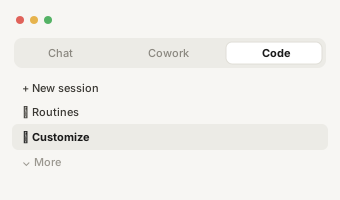
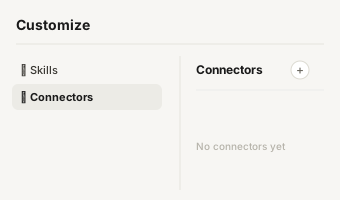
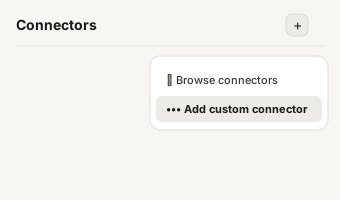
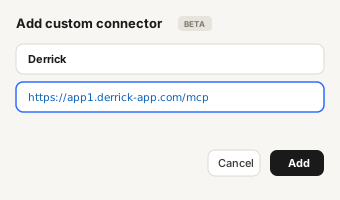
Pipeline, forecast, territory, ICP refresh: Derrick keeps the account and contact data behind them fresh. Work in the web app, or run the same enrichment from Google Sheets, Claude (MCP) or the API.

Compare sales tools →
Part 6 / 7

Common mistakes

Common mistakes

  • Treating OTE as guaranteed pay. It is target pay at full quota attainment, not a floor.
  • Pairing OTE with an unrealistic quota. A high OTE means little if almost no one hits the number behind it.
  • Wrong pay mix for the role. Too much variable on a role with little revenue control demotivates; too little on a closing role caps drive.
  • No accelerators. Flat commission above quota removes the incentive to overperform.
  • Comparing offers on OTE alone. Two offers with a similar OTE salary can pay very differently at 70% of quota. Compare the base and the attainment you expect.
  • Ignoring clawbacks and payment timing. Commission paid quarterly, or clawed back after a churned deal, changes the money you actually keep.
  • Forgetting the ramp. A first-year OTE assumes a full year at full quota. A new rep on a ramp won't earn the full variable in the first months.

Why teams choose Derrick.

Powerful features that save time and boost your sales pipeline.

ENRICHMENT

100+ data points on companies & leads.

AI POWERED

Built-in AI, no separate subscription.

FOUR SURFACES

The web app, Google Sheets, your AI assistant, or the API.

BEST VALUE

Same quality data, for a fraction of the cost.

From a search to a campaign, in one place

The four steps Derrick covers in the web app, and the features behind each one.

Any questions?

Stop copying data around. Start enriching.

What is OTE?

+
OTE stands for on-target earnings. It is the total pay a salesperson earns in a year when they reach 100% of quota: base salary plus the commission or bonus paid at target. A $100,000 OTE with a $60,000 base means $40,000 depends on hitting the number.

What is OTE in sales?

+
In sales, OTE is the headline number of a compensation plan. It adds the fixed base salary to the variable commission a rep earns at full quota. Job ads quote it because it shows what the role pays when things go to plan.

What does OTE mean for salary?

+
An OTE salary is not a salary in the usual sense. Only the base part is paid whatever happens. The rest is variable pay tied to quota. If an offer says $90K OTE on a 60/40 mix, your guaranteed base is $54,000 and $36,000 comes from commission at target.

Is on-target earnings guaranteed?

+
No. OTE is the total pay a rep earns at 100 percent of quota. The base salary portion is guaranteed, but the variable portion depends on performance. Miss quota and total earnings fall below OTE; beat it, often with accelerators, and they can rise above it.

How is OTE calculated?

+
OTE = base salary + variable pay at 100% of quota. Example: a $70,000 base plus $30,000 of commission at target gives a $100,000 OTE. If the annual quota is $600,000, the commission rate is $30,000 divided by $600,000, or 5% of revenue closed.

What does a 120K OTE mean?

+
It means $120,000 a year if you hit 100% of quota. On an illustrative 70/30 mix, that is an $84,000 base and $36,000 of commission. At 80% of quota you would earn about $112,800, and above 100% accelerators can take you past $120,000.

Is a high OTE a red flag?

+
Not always. It is one when the quota behind it is unrealistic or the base is thin. Ask what share of the team hit quota last year, what the average attainment was and what the quota-to-OTE ratio is. Clear answers point to a fair plan.

What is a good pay mix for OTE?

+
There is no single right split. It depends on how much the rep controls closing, the deal size and the length of the sales cycle. 50/50, 60/40 and 70/30 are common ways to write it. Treat any specific split you read as an example, not a benchmark, and judge it next to the quota.

What is the difference between OTE and base salary?

+
Base salary is the fixed pay a rep receives no matter what. OTE is base salary plus the variable pay earned at full quota attainment. OTE is always higher than base, because it includes target commission.

Can you earn more than your OTE?

+
Yes. OTE is pay at 100% of quota. Beat quota and you earn more commission, often at a higher rate thanks to accelerators, unless the plan caps earnings.
Start enriching LinkedIn profiles today

Open the Derrick web app, import a LinkedIn search or your own list, nothing to install. The free plan gives you 100 credits every month, no credit card.

Try the app free
or use it in
Google Sheets
Claude
API
100 credits free every month
1 credit per LinkedIn profile imported
5 credits per email found (paid plans)