
Outbound Sales: Definition, Process and Strategies That Work
Outbound sales means the seller reaches out first. The definition, the process step by step, pros and cons, techniques that still work, and the metrics.


When a sales team needs pipeline this quarter and cannot wait for inbound leads to trickle in, it turns to outbound. Done well, outbound sales is the most controllable growth channel a B2B company has: you decide who to target, when to reach them, and what to say. Done badly, it is spray-and-pray spam that burns your domain reputation. This guide defines outbound sales, weighs its advantages and disadvantages, walks through the process step by step, covers the channels, techniques, and metrics, and shows where the real leverage sits.
What is outbound sales?
Outbound sales is the practice of proactively initiating contact with potential buyers who have not raised their hand, in order to generate interest and book qualified conversations. Instead of waiting for a prospect to find your website and fill in a form, a sales rep identifies a target account, finds the right decision-maker, and reaches out first, usually through email, phone, or social. The goal of that first touch is rarely to close a deal; it is to earn a meeting.
The motion is typically run by sales development reps (SDRs) or business development reps (BDRs) whose full-time job is the top of the funnel: building lists, personalizing outreach, and qualifying replies before handing warm conversations to account executives. That division of labor is what separates a mature outbound engine from a founder sending the occasional cold email. If you are weighing this against pulling buyers in with content, our inbound vs outbound comparison lays out where each motion wins.
Outbound vs inbound sales
The difference comes down to who makes the first move. In outbound sales, the rep picks the account and opens the conversation. In inbound sales, the buyer finds you through search, content, or a referral and raises a hand first. Inbound sales leads are warmer but arrive on their own schedule, while outbound sales lets you decide who you talk to and when. Our inbound vs outbound sales breakdown compares the two motions side by side.
When outbound is the better first move. Outbound earns its keep when you sell to a well-defined, addressable market where you can name the exact companies and roles you want as customers. If your total addressable market is a few thousand named accounts rather than an anonymous mass audience, outbound lets you reach every one of them on purpose instead of hoping they stumble onto your content.
It is also the faster path to pipeline. Inbound sales compounds over months as content and search rankings mature, while a clean outbound list can book meetings this week. That makes outbound the natural choice for a new product with no audience yet, a sales team that needs pipeline this quarter, or an expansion into a new segment where you have zero inbound signal. Higher deal sizes tilt the math further toward outbound, because a single closed enterprise deal easily justifies the cost of the outreach. The strongest programs eventually run both, using outbound to create demand now and inbound to capture it later, but when you are starting from nothing, outbound is what puts meetings on the calendar first. Fit the choice to your go-to-market strategy rather than to fashion.
Advantages and disadvantages of outbound sales
Outbound sales is a trade. You get control and speed, and you pay for them in effort and in rejection. Both sides are worth seeing clearly before you build a team around it.
Advantages of outbound sales
- You choose the accounts. The list decides who hears from you, so the pipeline matches your ICP instead of whoever happened to land on your website.
- It is fast. A clean list can put meetings on the calendar within a couple of weeks, where content and search take months to compound.
- It is measurable at every step. Sends, replies, meetings, and opportunities can all be counted, so you can see which step leaks and fix that one.
- You can turn it up or down. Need more pipeline next quarter? Add accounts and reps. Inbound sales volume rarely moves that directly.
Disadvantages of outbound sales
- Low reply rates. Most people on a cold list never answer, so outbound sales only pays off with a list that fits, enough volume, and follow-up.
- A higher cost per meeting. Rep time, data, and sending tools add up, and every booked meeting carries that cost even when it goes nowhere.
- Deliverability risk. Mailbox providers watch bounces and spam complaints. Google's sender guidelines, enforced since February 2024, ask bulk senders to keep their reported spam rate under 0.3% (Google email sender guidelines). A sloppy list can push a whole domain into spam.
- It wears people down. Prospecting means a lot of silence and a lot of no. Without clear handoffs and realistic targets, SDR turnover follows.
None of this means you should skip outbound sales. Run it on a tight list with verified data: that is what brings the cost per meeting down and keeps the domain out of spam.
Who runs outbound: SDRs, BDRs, and AEs
A mature outbound engine is a team sport with clear handoffs. The sales development rep (SDR) owns the top of the funnel: building lists, sending sequences, and qualifying the replies that come back. In many companies a business development rep (BDR) plays a near-identical role, sometimes focused on net-new logos rather than existing accounts. Their entire job is to turn a cold list into booked, qualified conversations.
Once a prospect agrees to a meeting, the SDR hands it to an account executive (AE), who owns the deal from discovery through close. This separation matters because prospecting and closing are different skills that pull in different directions. A rep juggling both tends to neglect the patient, repetitive prospecting work the moment a live deal appears, and the pipeline dries up a quarter later. Smaller teams often blend the roles out of necessity, but even a solo founder benefits from treating prospecting and closing as separate blocks of time with separate goals. The structure is what turns sporadic outreach into a predictable, repeatable machine.
In the web app or Google Sheets
The address the sequence needs, per row
Outbound stops at the contact detail. From a name and a company domain already in your list, Derrick looks the professional email up across several sources and writes it back in the row. You are only charged when an address is returned.
- Feature
- Lead Email Finder
- Credit cost
- 5 credits per email found
The first button opens the web app (nothing to install): 5 credits per email found, available from the STANDARD plan. The second details the feature and its cost per plan.
How the outbound process works
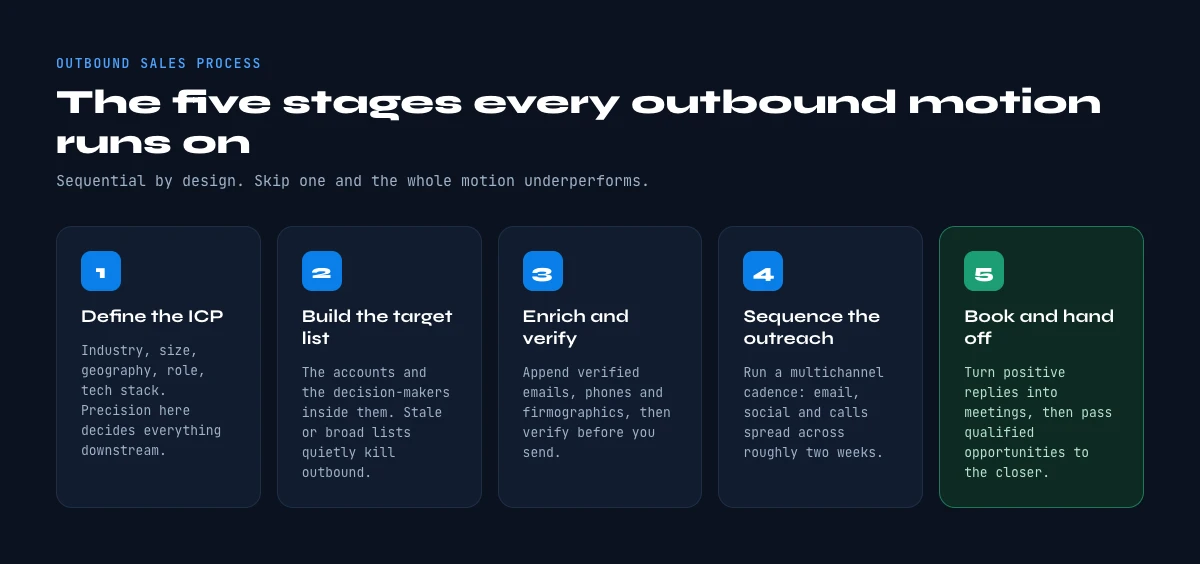
Every effective outbound motion follows the same backbone, whatever the tooling. The steps are sequential, and skipping one is the most common reason outbound underperforms.
- Define the ideal customer profile (ICP). Turn a vague target into concrete filters: industry, company size, geography, role, and the technology the account runs. Precision here decides everything downstream.
- Build the target list. Assemble the accounts and the specific decision-makers inside them that match the ICP. This is where most outbound programs quietly fail, because the list is stale or too broad.
- Enrich and verify. Append verified emails, phone numbers, and the firmographic detail your messaging needs, then verify deliverability before you send anything.
- Sequence the outreach. Design a multi-touch cadence across channels rather than a single email. Most replies come from the third to fifth touch, not the first.
- Qualify and hand off. Score replies, book the qualified ones, and route them to an account executive with the context already attached.
The through-line is that outbound sales is a data problem before it is a copywriting problem. A brilliant message sent to a wrong or unverified contact produces nothing. Get the list and the data right, and average copy still books meetings.
The main outbound channels
Modern outbound is multichannel by default, because buyers ignore any single channel. The three pillars each play a distinct role.
| Channel | What it is good for | Watch out for |
|---|---|---|
| Cold email | Scale and asynchronous reach; the backbone of most sequences | Deliverability: an unverified list wrecks your sending reputation fast |
| Cold calling | Speed and directness; a live conversation beats ten emails | Time-intensive; needs accurate direct-dial numbers to be worth it |
| Social selling | Warming and research; visibility before the ask | Slow on its own; works best paired with email and calls |
The winning pattern is not choosing one channel but sequencing them: a social touch to get on the radar, an email with a clear reason for reaching out, a call to create a real conversation, then a follow-up email. Each channel covers the others' blind spots.
There is also a middle ground between cold and inbound. Warm outbound reaches people who already showed a signal, such as a visit to your pricing page or a comment on a post, so the first message has a reason behind it.
The app works through your list row by row: 5 credits per email found, nothing is billed without a result.
Outbound sales techniques that still work
Channels tell you where to reach people. Techniques tell you how. These six outbound sales techniques hold up across industries because each one raises relevance without raising volume.
- Signal-based outreach. Reach out when something just changed at the account: a new hire in the buying role, a funding round, a new office, a job post that hints at the problem you solve. The signal gives your first line a reason to exist.
- Multi-threading. Contact two or three people on the same buying committee instead of one. If your champion goes quiet or leaves, the deal does not leave with them.
- Account-level personalization. Personalize to the company, not only to the person. One sentence about what the account is doing right now beats a compliment on someone's latest post.
- A multichannel cadence. Plan email, phone, and social touches as one sequence with a set rhythm, so each touch builds on the last one instead of repeating it.
- Call and email on the same day. A call a few hours after an email gives the prospect context ("I sent you a note this morning") and makes the email easier to find.
- Clean the list before you write. Verify emails and direct dials before the sequence starts. The best copy in outbound sales does nothing if a quarter of it bounces.
Test one technique at a time and read the reply rate before you add the next. Stack five changes in one campaign and you will never know which one worked.
Building an outbound sequence step by step
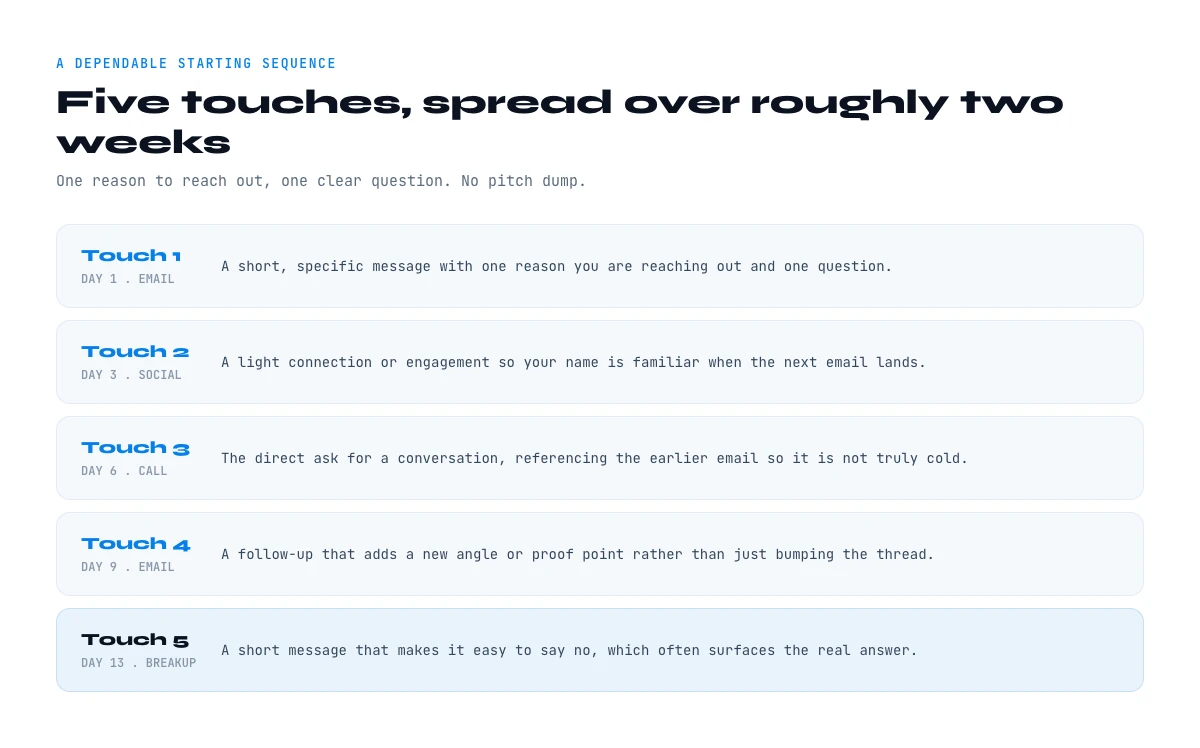
A sequence is the repeatable cadence a rep runs against every contact on the list. A dependable starting structure looks like this, spread over roughly two weeks:
- Touch 1, email: a short, specific message with one clear reason you are reaching out to this account, and one question. No pitch dump.
- Touch 2, social: a light connection or engagement so your name is familiar when the next email lands.
- Touch 3, call: the direct ask for a conversation, referencing the earlier email so it is not truly cold.
- Touch 4, email: a follow-up that adds a new angle or proof point rather than just bumping the thread.
- Touch 5, breakup email: a short message that makes it easy to say no, which often surfaces the ones who were simply busy.
The sequence only works on top of a clean list. If a third of your contacts bounce, the cadence is irrelevant, so verification is not an optional step, it is the foundation the whole sequence stands on.
An outbound sales example in practice
Concrete beats abstract, so here is what a small outbound sales motion looks like end to end. Imagine a company selling a project-management tool to mid-market marketing agencies in the United States. The ICP is precise: marketing agencies, 20 to 200 employees, US-based, with an in-house creative team. That definition is the whole game, because it decides who lands on the list and who does not.
The rep builds a list of 200 agencies that fit, then identifies the head of operations at each one as the decision-maker. Every contact is enriched with a verified work email and a direct line, and the list is checked for deliverability before anything sends, so the bounce rate stays near zero. The rep then runs a five-touch, two-week sequence across email, a light social touch, and a call, personalizing the first line of each email to something specific about that agency.
Out of 200 contacts, a healthy motion might see 15 to 20 replies, half of them positive, converting to 8 to 10 booked meetings. From those, two or three become real opportunities, and one closes over the following weeks. Nothing here is magic. The result comes from the precision of the list and the cleanliness of the data far more than from clever wording, which is exactly why the data layer is where you should invest first.
The outbound metrics that matter
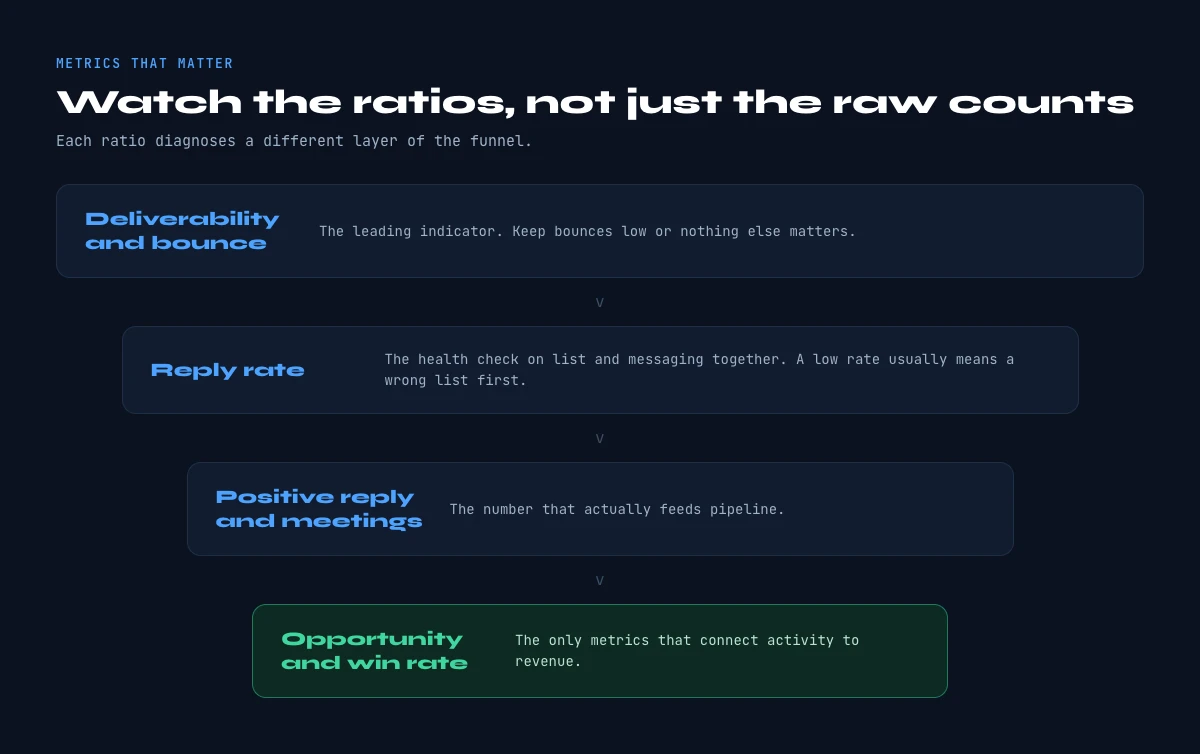
Outbound is measurable end to end, which is one of its biggest advantages over brand-building. Watch the ratios, not just the raw counts:
- Deliverability and bounce rate: the leading indicator. Keep bounces low or nothing else matters.
- Reply rate: the health check on your list and your messaging together. A low reply rate usually means a wrong list before it means bad copy.
- Positive reply and meeting-booked rate: the number that actually feeds pipeline.
- Opportunity and win rate: the only metrics that connect outbound activity to revenue. Track leads all the way through, not just to the meeting.
Benchmark your funnel against the 2026 B2B marketing performance data so you know whether your reply and conversion rates are normal or a signal that the list needs work.
Read the funnel top to bottom before you change anything. A high bounce rate points at the data, a low reply rate at the list or the message, and strong replies that never become opportunities point at qualification or fit. Each symptom has a different cure, and chasing the wrong one is how teams waste a quarter rewriting copy when the real problem was a stale list. Let the ratios tell you which lever to pull, and change one thing at a time so you can actually learn what moved the number.
To see what those ratios mean for your own outbound sales targets, run the funnel backwards from the deals you need to close:
Outbound pipeline math
Work back from the deals you need to the contacts you have to source. Nothing leaves your browser.
Fill the six fields and press Calculate.
The unusable share is the input teams guess and get wrong. Take it from the last campaign report rather than from memory: hard bounces, role addresses, and everyone who replied that they have left the company. The credit line below prices the email lookup only, at 5 credits per address found; sourcing and verification are separate calls with their own cost.
Common outbound mistakes to avoid
Most struggling outbound programs share the same handful of failures:
- A list that is too broad. Casting wide feels productive and converts terribly. A tight, well-defined list beats a big one every time.
- Skipping verification. Sending to unverified contacts spikes bounces and quietly kills deliverability for every future campaign.
- One touch and done. Giving up after the first email leaves the majority of replies on the table.
- Generic messaging. A message that could go to anyone gets ignored by everyone. Relevance beats volume.
- Chasing bad-fit accounts. Outbound to companies outside your ICP is expensive noise. Aligning outbound with your account-based marketing targets keeps the effort where it pays.
How clean data powers outbound sales
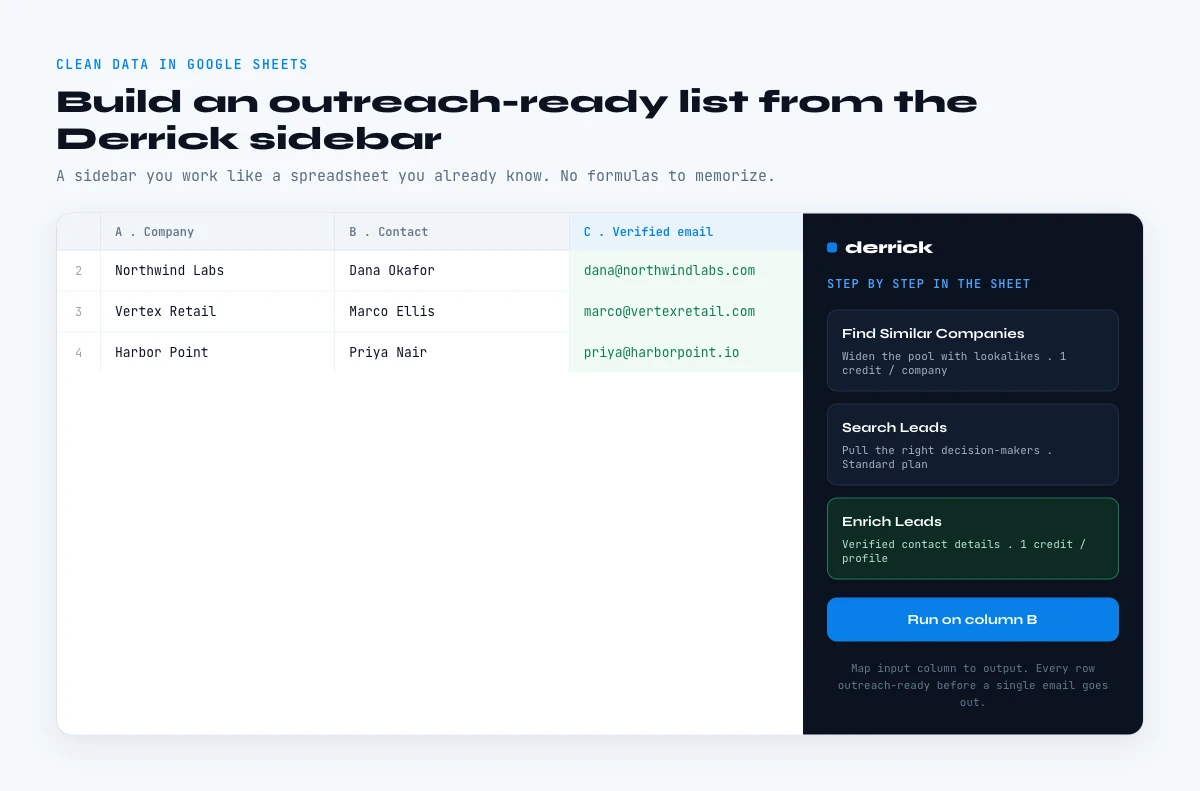
Every failure mode above traces back to the same root: the list and the data underneath it. That is the part Derrick is built to fix, in the web app or in Google Sheets. Derrick runs in its web app or as a Google Sheets sidebar, not as a wall of formulas to memorize, so building a prospect list feels like working a list you already know. The data that decides everything downstream is who you aim at: Walmart's executive line-up shows which function owns the problem you solve, and a page like who runs global field operations at Oracle shows how precise a target can get before you write a word.
You start from a set of target accounts and widen the pool with Find Similar Companies to reach lookalikes you would not have listed by hand. You pull the right decision-makers with Search Leads (paid plans, from Standard) and fill in their job title, company, and location with Enrich Leads at 1 credit per profile. Both read LinkedIn, so they need your LinkedIn account connected through the Derrick Chrome extension. Email Finder then adds the work email at 5 credits per email found, and Phone Finder the direct dial at 200 credits per number found (both on paid plans), so every row is outreach-ready before a single email goes out. The result is the clean, verified list that the sequence, the channels, and the metrics all depend on.
The economics make outbound sales accessible to any team. The Free plan includes 100 credits per month at no cost to test the workflow in the web app, and paid plans start at 20 EUR a month; unused credits carry over as long as the account stays on a paid plan. The same workflow runs in the web app, in Google Sheets, in Claude through MCP, or over the REST API (API and MCP from the Plus plan). Because Derrick scales from a handful of rows to tens of thousands, the same workflow serves your first outbound test and the recurring list build of a full SDR team. Once the pipeline exists, our buy vs build guide for lead generation shows why owning this in-house usually beats renting it.
Outbound sales rewards discipline over volume: a precise list, verified data, and a patient multi-touch sequence. Nail those and the channel becomes the most predictable pipeline you own, one you can turn up or down at will instead of waiting on demand you cannot control. The teams that win at outbound are not the ones with the cleverest scripts, they are the ones with the cleanest lists. Try Derrick free with 100 credits per month and build your first verified outbound list in the web app or in Google Sheets today.
Frequently asked questions
What is outbound sales?
What is the difference between inbound and outbound sales?
What are the benefits of outbound sales?
What are common challenges with outbound sales?
What channels does outbound sales use?
How do you measure outbound sales?
Why does outbound sales fail?
Do I need a data tool for outbound sales?
Keep reading
Continue exploring this cluster


The State of B2B Marketing Performance 2026: Benchmarks Report
Read →

Account-Based Marketing (ABM): Definition, Techniques, Examples
Read →

Inbound vs Outbound Marketing: Differences, When to Pick Each
Read →

B2B Lead Generation: Strategies, Tools, Tips in 2026
Read →