
Account-Based Marketing (ABM)
Learn what account-based marketing (ABM) is, how to build an ABM marketing strategy in 7 steps, with examples by tier and the metrics that prove it works.


ABM stands for account-based marketing: a B2B strategy where sales and marketing agree on a named list of high-value accounts and run coordinated campaigns against that list, instead of chasing volume and filtering later. The unit of work is the account, not the individual lead, and success is measured in pipeline and revenue per account rather than in lead count.
Account-based marketing flips the usual lead-generation funnel. Instead of attracting a wide pool of leads and filtering down, you start from a defined list of high-value accounts and concentrate sales and marketing on winning them. This guide explains what ABM is, its benefits, how to build an account-based marketing strategy in seven steps, its three tiers, account-based marketing examples, the channels and tools it uses, how to measure it, how it compares with demand generation and inbound marketing, and the most common mistakes and barriers. If you searched for ABM marketing, it is the same thing: the M already stands for marketing, and ABM marketing simply means account-based marketing.
What is account-based marketing (ABM)?
Account-based marketing is a B2B strategy that treats each high-value target account as a market of one. Sales and marketing pick the accounts together, then run coordinated, personalised campaigns to win them.
Put another way, ABM focuses sales and marketing on a defined set of high-value target accounts instead of a broad pool of leads. Rather than casting a wide net for leads, ABM coordinates personalised outreach across channels to win and grow specific named companies.
The logic is simple: in most B2B markets a small number of accounts drive the majority of revenue, so spreading effort evenly across thousands of leads wastes it. ABM concentrates time, budget, and creativity on the accounts most likely to become large, lasting customers. It is a team sport: sales and marketing agree on the same target list and work it together, which is why ABM is as much an alignment discipline as a marketing tactic.
Benefits of ABM for B2B teams
Why do B2B teams adopt account-based marketing? Because focus pays. The benefits all come from working fewer accounts, more deeply:
- Bigger, better-fit deals. Effort goes to target accounts that match your ideal customer profile, so the deals you win tend to be larger and the customers stay longer.
- Less wasted budget. Ads, content and outreach reach named companies instead of anyone who happens to click.
- Real sales and marketing alignment. Both teams work one list and one scoreboard, which ends the argument about lead quality.
- A clearer return on investment. Results are read account by account: did this company move toward a deal or not.
- Room to expand. The account plan does not stop at the first contract; upsell and cross-sell live in the same motion.
None of these benefits is automatic. They show up when the account list is right and both teams actually share it.
How account-based marketing works
ABM runs as a repeatable loop rather than a one-off campaign. The core steps:
- Define the ideal account. Build an ideal customer profile from your best existing customers (industry, size, technology, growth signals).
- Select target accounts. Turn that profile into a named list, usually tiered by value and fit.
- Map the buying committee. Identify the economic buyer, champion, users, and any blockers inside each account.
- Personalise. Tailor content, ads, and outreach to each account's industry, situation, and stakeholders.
- Engage across channels. Coordinate email, social, ads, events, and direct outreach so the account meets a consistent message.
- Measure and expand. Track engagement and pipeline at the account level, then grow won accounts over time.
Everything downstream depends on the first two steps. A precise, well-built target list is the foundation of ABM, because personalised outreach aimed at the wrong company, or the wrong person inside it, wastes the very effort that makes ABM expensive. That is why the account list and the contact data behind it deserve more care than any single campaign asset.
A concrete example. Say you sell a compliance platform to mid-market financial firms. You define the ICP (regulated financial companies, 200 to 2,000 employees, in your region), build a named list of 60 accounts that match, and tier them: 10 strategic banks as one-to-one, 50 others as one-to-few. For each one-to-one account you map the buying committee (a Head of Compliance as champion, a CFO as economic buyer, an IT lead as a likely blocker), run targeted ads to those roles, send a tailored business case, and have the account executive reach out with a relevant hook. Marketing and sales review the 10 accounts together every week. The metric is not how many leads the campaign produced, but whether those 10 named banks moved closer to a deal. That is ABM in practice: narrow list, deep personalisation, account-level scoreboard.
How to build an account-based marketing strategy in 7 steps
An account-based marketing strategy is the written plan that says which accounts you will pursue, who you will talk to inside them, with what message and through which channels. Most programmes follow the same seven steps.
- Set the goal and the budget. Decide what the programme must produce in the next two or three quarters: new logos in one segment, expansion inside existing customers, or a shorter cycle on large deals. One goal per programme keeps the scoreboard honest.
- Write the ideal customer profile. Start from your best current customers and note what they share: industry, headcount, region, tech stack, growth stage. Our guide to the ideal customer profile in sales walks through the method.
- Build the list of target accounts. Turn the profile into named companies. A first list should stay short, a few dozen to a few hundred target accounts for the first quarter, tiered right away into one-to-one, one-to-few and one-to-many.
- Map the buying committee. For each account, find the people who decide, influence and block: economic buyer, champion, users, finance, IT or procurement. A target account with no named contacts is still a wish, not a target.
- Plan content by tier. One-to-one accounts get bespoke assets, such as a business case or a tailored demo. One-to-few clusters get a version written for their industry. One-to-many accounts get messaging driven by data.
- Pick and coordinate the channels. Ads aimed at the account, email, LinkedIn, events and the account executive's own outreach. Write down who touches each account, when, and with what message.
- Measure, review, re-tier. Review the target accounts every week or two with sales: engagement, meetings, pipeline. Move accounts up or down a tier as signals change, and refresh the list every quarter.
The order matters. Teams that jump to step 6 and launch ads before steps 3 and 4 end up paying for impressions on companies nobody will ever call. A sound ABM plan is mostly list work up front and coordination afterwards, and the ABM strategy document only needs to be as long as those seven answers.
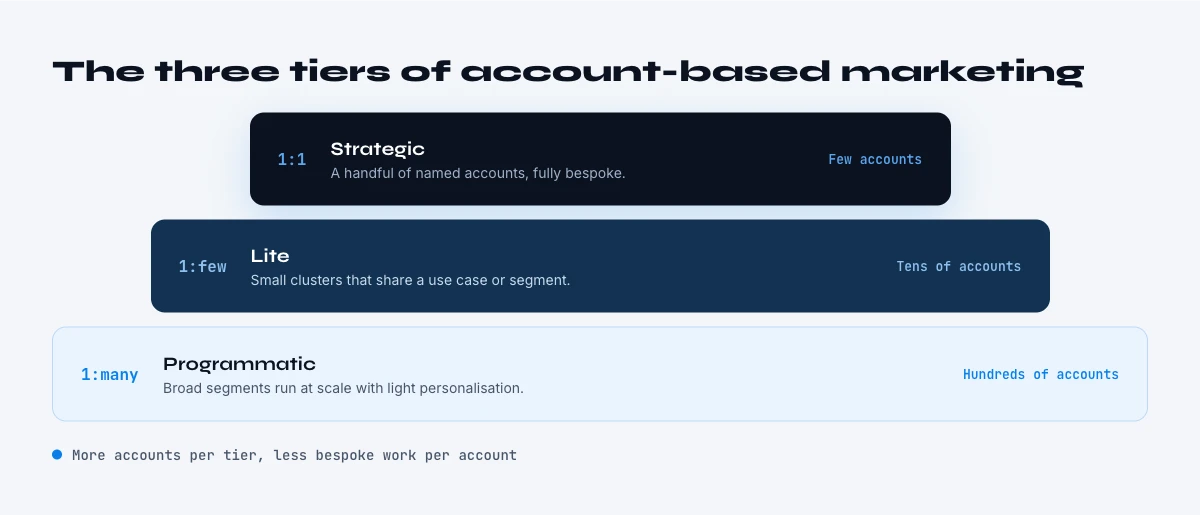
The three tiers of account-based marketing
ABM is usually run in three tiers, which trade depth of personalisation against the number of accounts you can cover.
| Tier | Accounts | Personalisation | Best for |
|---|---|---|---|
| One-to-one (strategic) | 10 to 50 | Fully bespoke per account | Largest, most strategic deals |
| One-to-few (cluster) | Dozens to a few hundred | Tailored by industry or use-case cluster | Similar accounts grouped together |
| One-to-many (programmatic) | Hundreds to thousands | Light, data-driven personalisation | Scaling ABM with firmographic and intent data |
Most mature programs run all three at once: a handful of one-to-one accounts get dedicated plans, a middle band gets clustered campaigns, and a broad base gets programmatic targeting. The right tier for an account depends on its potential value and how much you know about it.
In the web app or Google Sheets
Build the target account list ABM depends on
ABM stalls when the account list is a guess. Start from the accounts you already closed, paste them in a list, and Derrick returns lookalike companies with their LinkedIn page and domain, so the tier 1 list rests on your own won deals.
- Feature
- Find Similar Companies
- Credit cost
- 1 credit per company found
The first button opens the web app (nothing to install): 1 credit per company found, 100 free credits every month. The second details the feature and its cost per plan.
Account-based marketing examples
Here are three account-based marketing examples, one per tier. They are composite scenarios, not case studies: the numbers describe the setup, not a result.
One-to-one: a strategic expansion account. An HR software vendor already sells to one business unit of a large retail group and wants the rest of the group. Marketing and the account executive write a single account plan: the five people who matter at group level, the two projects on their roadmap, the internal champion who can open doors. Every asset is made for this one company: a business case built on its own numbers, an executive briefing, ads shown only to its employees. The weekly review asks one question: did we get closer to the group-level decision?
One-to-few: a cluster of similar target accounts. A logistics software company picks 40 regional carriers facing the same new reporting obligation. One campaign is written for the cluster, a guide, a webinar and an email sequence about that obligation, then lightly adapted per account (fleet size, region). Sales follows up with the accounts that engage the most.
One-to-many: programmatic ABM on a large list. A cybersecurity vendor builds a list of 1,500 mid-sized companies that match its profile and run a given cloud stack. Personalisation happens by segment, not by account: ads by industry, landing pages by vertical, and an alert to sales when an account shows activity, such as hiring for security roles. It is the most scalable form of ABM, and the one that depends most on clean account data.
What these three scenarios share: the list comes first, and the scoreboard is the account, not the lead.
Account-based marketing channels
ABM is multi-channel by design, because a buying committee is reached in more than one place. Common channels include targeted advertising aimed at named accounts, personalised email and social outreach to specific stakeholders, tailored landing pages and content, events and webinars for priority accounts, and direct mail for high-value one-to-one targets. The point is coordination: the same account should encounter a coherent message from marketing and sales across each touch, rather than disconnected campaigns. This is where sales and marketing alignment pays off, since both teams are working the same named list at the same time. LinkedIn deserves its own playbook here, because it is where most buying committees can be reached by name: see our guide to LinkedIn account-based marketing.
ABM tools by category
No single tool runs ABM. A working stack has five categories, and most teams already own two or three of them.
- CRM. The system of record for accounts, contacts, deals and the tier of each account. Everything else syncs back to it.
- Account and contact data. Builds and enriches the list: firmographics, tech stack, hiring, the people in the buying committee and how to reach them. This is where Derrick sits.
- Intent and signals. Tells you which target accounts are active now, from visits to your own site to research activity on the wider web.
- Targeted advertising. Shows ads to people inside named companies, on LinkedIn and display networks, rather than to a broad audience.
- Orchestration and outreach. Sequences email and LinkedIn touches, alerts sales, and keeps marketing and sales plays in step.
Choose the data layer first: ads, intent and sequences all run on the list, and a wrong list makes every other tool expensive. With Derrick, the list is built in the web app, or in a Google Sheets sidebar if your team works in spreadsheets; the REST API (from the PLUS plan, €47.50 a month) keeps enriched accounts in sync with your CRM, and the MCP server lets you ask Claude about a single account in the middle of a conversation.
The app works through your list row by row: 1 credit per company found, nothing is billed without a result.
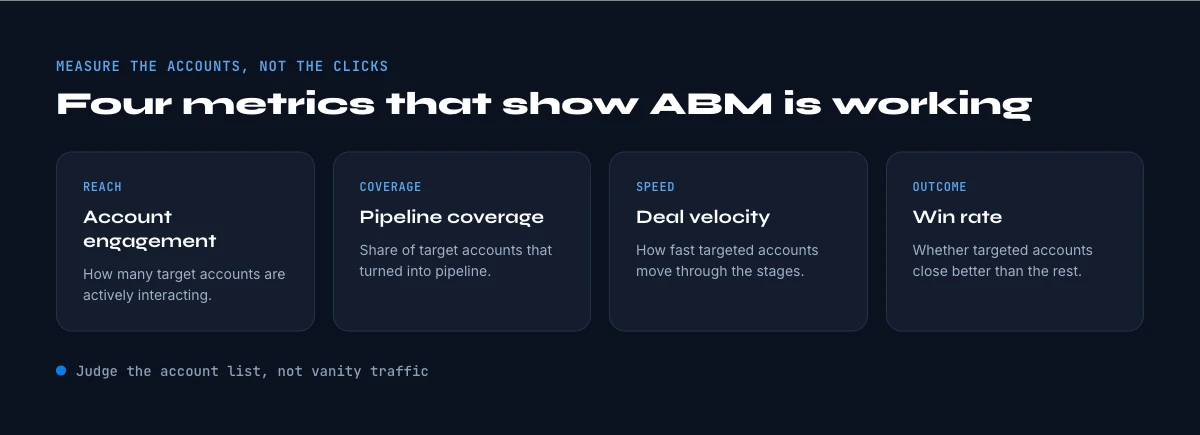
How to measure account-based marketing
ABM is measured at the account level, not by raw lead volume, which is the biggest reporting shift teams make when they adopt it. Useful metrics include account engagement (how many stakeholders in a target account are interacting), pipeline created within the target list, win rate on targeted accounts, average deal size, and expansion revenue from won accounts. Vanity metrics like total leads or clicks matter far less here, because the whole point of ABM is to move specific accounts toward a deal. A program that generated thousands of clicks but did not advance any named account has failed by ABM standards, even if it looks busy.
It helps to split metrics into leading and lagging indicators. Leading indicators move early and tell you whether the program is working before revenue lands: the share of target accounts showing engagement, the number of stakeholders reached per account, and meetings booked within the list. Lagging indicators confirm the outcome: pipeline created, win rate, deal size, and expansion on won accounts. A useful habit is an account-engagement score that rolls up the signals for each target account into a single number, so sales and marketing can see at a glance which accounts are heating up and deserve more attention, and which have gone cold. Reviewing that score together, on the shared account list, keeps both teams pointed at the same priorities rather than optimising separate dashboards.
ABM versus demand generation
Demand generation casts a wide net to create and capture leads across a broad audience, then qualifies them down. ABM starts from a defined set of named, high-value accounts and works each one in depth. They are not rivals: most teams run both, using demand generation for volume and reach, and ABM for the strategic accounts that justify a personalised, coordinated effort. The deciding factor is deal economics. ABM costs more per account, so it pays off only when deals are large enough to reward the extra effort, which is why it is most common in enterprise and large mid-market selling. For the neighbouring distinction, read demand generation vs lead generation.
Account-based marketing vs inbound marketing
Inbound marketing attracts people who are already looking: content, search and social bring visitors in, and forms turn them into leads. Account-based marketing goes the other way: you choose the companies first, then go to them. Inbound is a net; ABM is a list.
| Criterion | Inbound marketing | Account-based marketing |
|---|---|---|
| Starting point | Content that attracts an audience | A named list of target accounts |
| Who you reach | Anyone who finds you | The buying committee of chosen companies |
| Personalisation | By persona or topic | By account, or by cluster of accounts |
| Main metric | Leads, MQLs, conversion rate | Engagement and pipeline per account |
| Role of sales | Follows up on leads that come in | Works the accounts with marketing from day one |
| Best fit | Many buyers, smaller deals | Few buyers, large deals |
The two are not rivals. Inbound content gives an ABM programme something useful to send, and a visit from a target account to your pricing page is one of the clearest signs it is time to call. A common setup is inbound for the long tail and ABM for the accounts big enough to justify a plan of their own. For the wider picture of motions, read our comparison of inbound versus outbound sales and marketing.
Common account-based marketing mistakes and barriers
- Targeting too many accounts. ABM rewards focus; a bloated list dilutes the personalisation that makes it work.
- No sales and marketing alignment. If the two teams pick different accounts or work in silos, the coordinated motion falls apart.
- Shallow personalisation. Dropping a company name into a generic email is not ABM; relevance to the account's real situation is.
- Starting from a weak list. Personalised outreach to badly chosen accounts, or to outdated contacts, wastes the entire investment.
- Measuring by lead volume. Judging ABM on clicks and leads instead of account engagement and pipeline hides whether it is actually working.
- Barrier: sales does not buy in. If reps keep working their own accounts, ABM becomes a marketing campaign with nobody to close. Get sales to co-sign the list of target accounts before launch.
- Barrier: incomplete account data. Missing headcount, outdated contacts and unknown committee members turn tiering into a guess and make personalisation impossible. Fix the data before scaling the programme.
When account-based marketing is the right strategy
ABM is powerful, but it is not the default for every business. It earns its higher cost per account in a specific set of conditions, and forcing it where those do not hold wastes money. The strongest signals that ABM fits:
- High deal value. Each customer is worth enough that a personalised, multi-touch effort pays back. ABM rarely makes sense for low-price, self-serve products.
- A concentrated market. A finite, identifiable set of companies could realistically buy, so naming them is possible. If your market is millions of undifferentiated buyers, demand generation fits better.
- A considered, multi-stakeholder purchase. Several people shape the decision, which rewards the account-level coordination ABM is built for.
- A sales-led motion. There is a sales team to work the accounts marketing surfaces; ABM without sales to close is half a strategy.
- A clear ideal customer profile. You know what a good account looks like, so the target list is grounded in data rather than guesswork.
When most of these are true, ABM concentrates effort where it compounds. When they are not, a broad demand-generation motion will usually return more for the same budget. Many companies run a hybrid: demand generation for the long tail, ABM for the strategic accounts that clear the bar above.
Sales and marketing alignment in ABM
ABM only works when sales and marketing operate as one team against the same list. This is the single biggest predictor of whether a program succeeds, and the most common reason it fails. The operating model has a few non-negotiable parts.
First, a shared target-account list: both teams agree on the named accounts and their tiers, so marketing is not generating demand for companies sales will never work, and sales is not chasing accounts marketing cannot support. Second, agreed definitions and handoffs: what counts as an engaged account, when marketing passes it to sales, and what sales commits to do in return, often written as a service-level agreement. Third, joint account reviews: regular meetings where both teams look at the same accounts, decide next steps, and adjust tiers as accounts heat up or go cold. Fourth, shared metrics: both teams are measured on account engagement and pipeline, not on separate lead and revenue numbers that pull them apart. When these are in place, the buyer experiences one coordinated company rather than two disconnected departments, which is the entire promise of ABM.
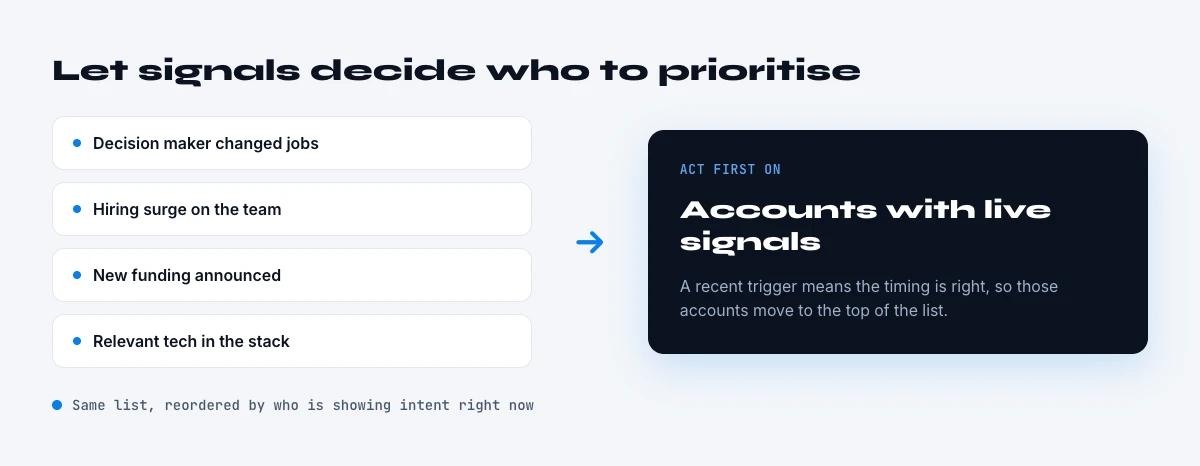
Using intent data and signals to prioritise
A static target list tells you who fits, but not who is ready to buy now. Intent data and engagement signals add that timing layer, helping teams decide which accounts to push and when. Signals come in two broad kinds: first-party (visits to your site, content downloads, event attendance, replies) and third-party (research activity across the web suggesting an account is exploring your category). Used well, signals let you move an account up a tier when it shows in-market behaviour, time outreach to the moment of interest, and personalise around the topic the account is actually researching.
The important caveat is that signals supplement a clean, well-built account list; they do not replace it. Chasing every spike of activity without an ideal customer profile leads back to spray-and-pray. The disciplined pattern is to start from a defined target list grounded in your ICP, keep the underlying account and contact data accurate, then layer signals on top to prioritise and time the work. Data quality first, signals second. For a catalogue of what to watch, see our guide to B2B buying signals.
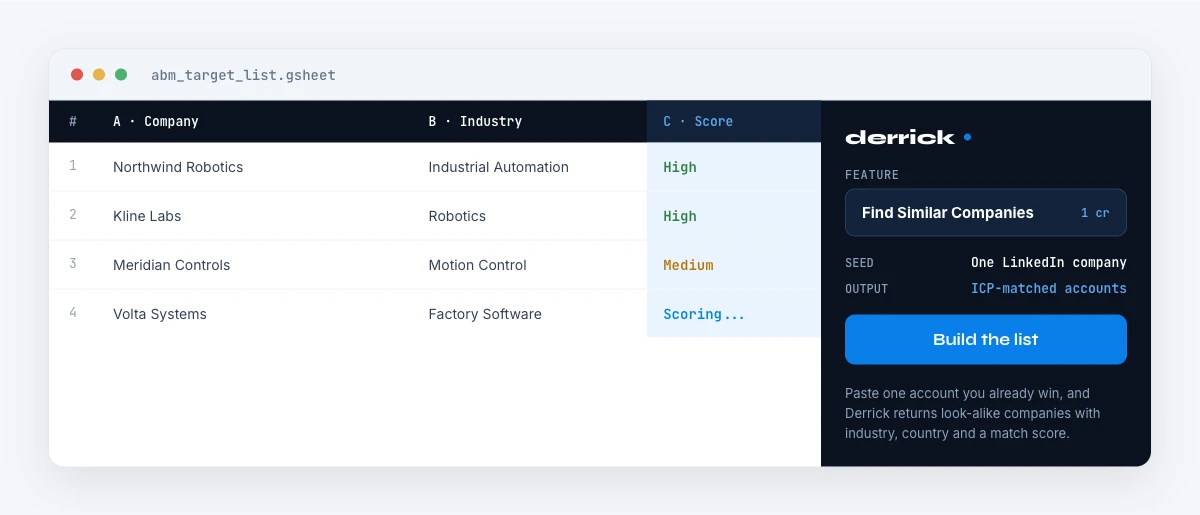
Build your ABM target list in the web app or Google Sheets
To start from a ready-made structure, copy the free target account list template for Google Sheets: firmographics, tech stack, hiring signal, decision maker and a tier column, one account per row.
Once your list is built and enriched, the rest of the ABM motion follows: tier the accounts, map the committee, and coordinate channels. For the broader picture of how ABM fits your funnel, see our guide to B2B lead generation and the difference between inbound and outbound marketing. To benchmark your numbers, read the State of B2B Marketing Performance 2026, or browse the full B2B marketing hub.
Frequently asked questions
What is account-based marketing in simple terms?
What is the difference between ABM and demand generation?
What are the three tiers of ABM?
How do you measure account-based marketing?
Is ABM only for enterprise sales?
How do you build an ABM target account list?
What does ABM stand for?
Isn't ABM just detailed, data-driven ad targeting?
Keep reading
Continue exploring this cluster


Inbound vs Outbound Marketing: Differences, When to Pick Each
Read →

B2B Lead Generation: Strategies, Tools, Tips in 2026
Read →

Go-to-Market Strategy: B2B Framework & 7 Steps (2026)
Read →

Lead generation company
Read →