
B2B Cold Call Script: 8 Cold Calling Scripts That Get to the Decision-Maker
Copy 8 B2B cold call scripts for gatekeepers, voicemail, follow-ups, referrals and software sales, plus the five objections and the connect math.


Every guide to cold calling hands you a script and stops there. The script is the easy part. A B2B cold call script only starts working on a call that connects, and whether a call connects is decided before anyone speaks: by the number on the row, by whether that number still belongs to the person, and by whether it rings on a desk that anyone still sits at.
This page gives you the script in full, block by block, eight cold calling scripts in all (the full call plus seven situations you can copy), the objection lines and the voicemail. It also gives you the part the template posts leave out: the four columns your list needs before the script gets a chance to matter, and the arithmetic that tells you whether your problem is the wording or the file.
Here is the whole structure on one screen. If you only came for the words, jump straight to the full script.
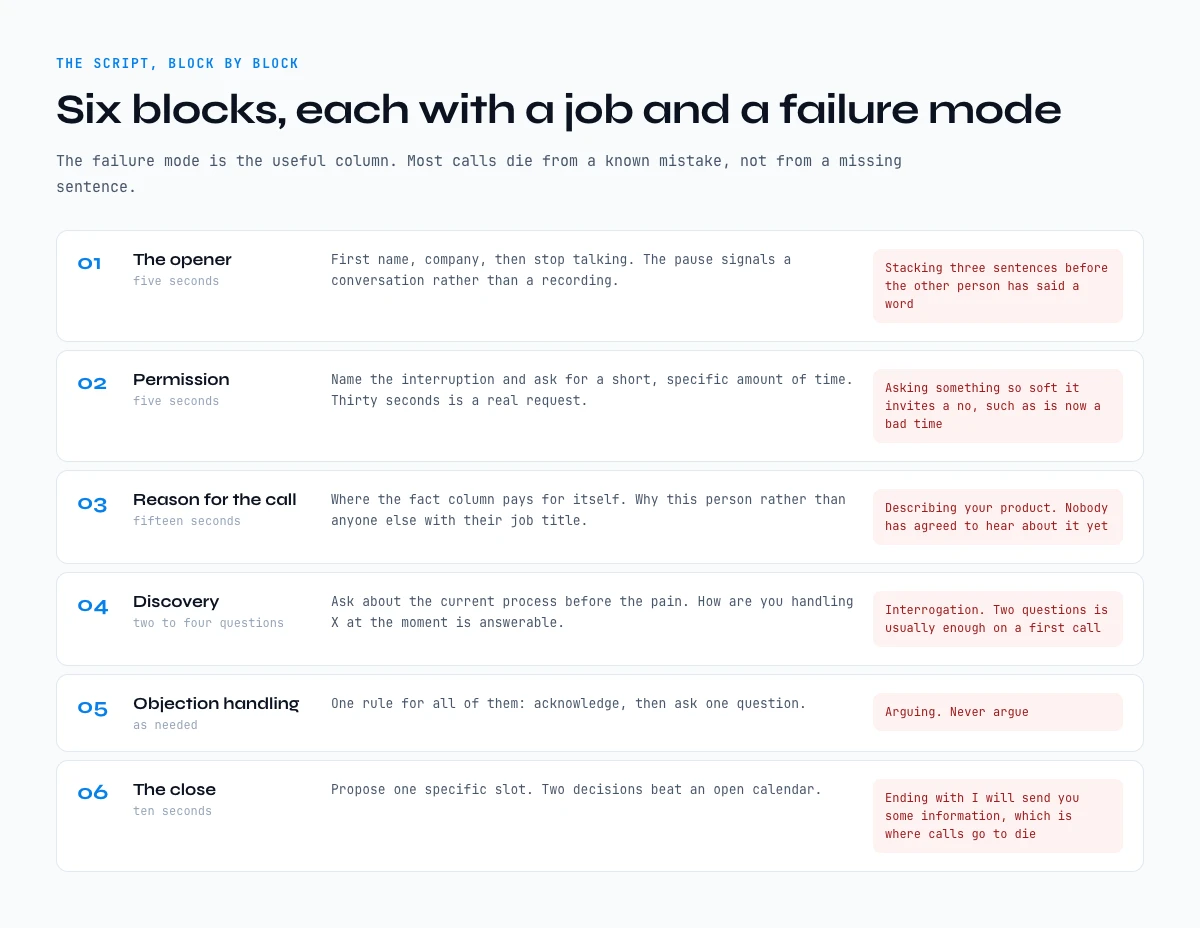
| Block | Length | Its one job |
|---|---|---|
| 1. Opener | 5 seconds | Sound like a person, then stop talking |
| 2. Permission | 5 seconds | Name the interruption, ask for a specific length of time |
| 3. Reason for the call | 15 seconds | Say why this person, not anyone with their title |
| 4. Discovery | 2 to 4 questions | Ask about the current process, not the pain |
| 5. Objection handling | As needed | Acknowledge, then ask one question |
| 6. Close | 10 seconds | Propose one specific slot |
What a B2B cold call script actually is (and what it cannot fix)
A B2B cold call script is a written structure for a first, uninvited conversation with someone who did not ask to hear from you. It is not a monologue to recite. Read word for word it fails, because the person on the other end can hear reading. What it does is remove the three seconds of hesitation after the pick-up, keep the call moving when the answer surprises you, and make two calls by two different reps comparable enough that you can learn something from the difference. If you want the definition first, here is what a cold call is.
Here is what it cannot fix. It cannot fix a number that rings in an empty office. It cannot fix a switchboard that routes you to an automated menu. It cannot fix a record where the job title is two roles out of date, so your opener names a problem that stopped being theirs a year ago. Those are file problems, and no amount of rewriting the opener touches them.
That distinction matters because the two failures feel identical on a bad day. Thirty dials, no meetings, and you go rewrite the script. If the calls never connected, you just rewrote something nobody heard.
Does cold calling still work?
Yes, on the evidence that exists. In a RAIN Group Center for Sales Research study published in January 2018 and covering 488 buyers, 82 percent said they accept meetings with sellers who reach out to them, and 54 percent said the seller behind the last meeting they agreed to had reached them by phone (RAIN Group study announcement). The study is a few years old. Read it as a direction, not as today's rate.
The arithmetic nobody puts next to the script
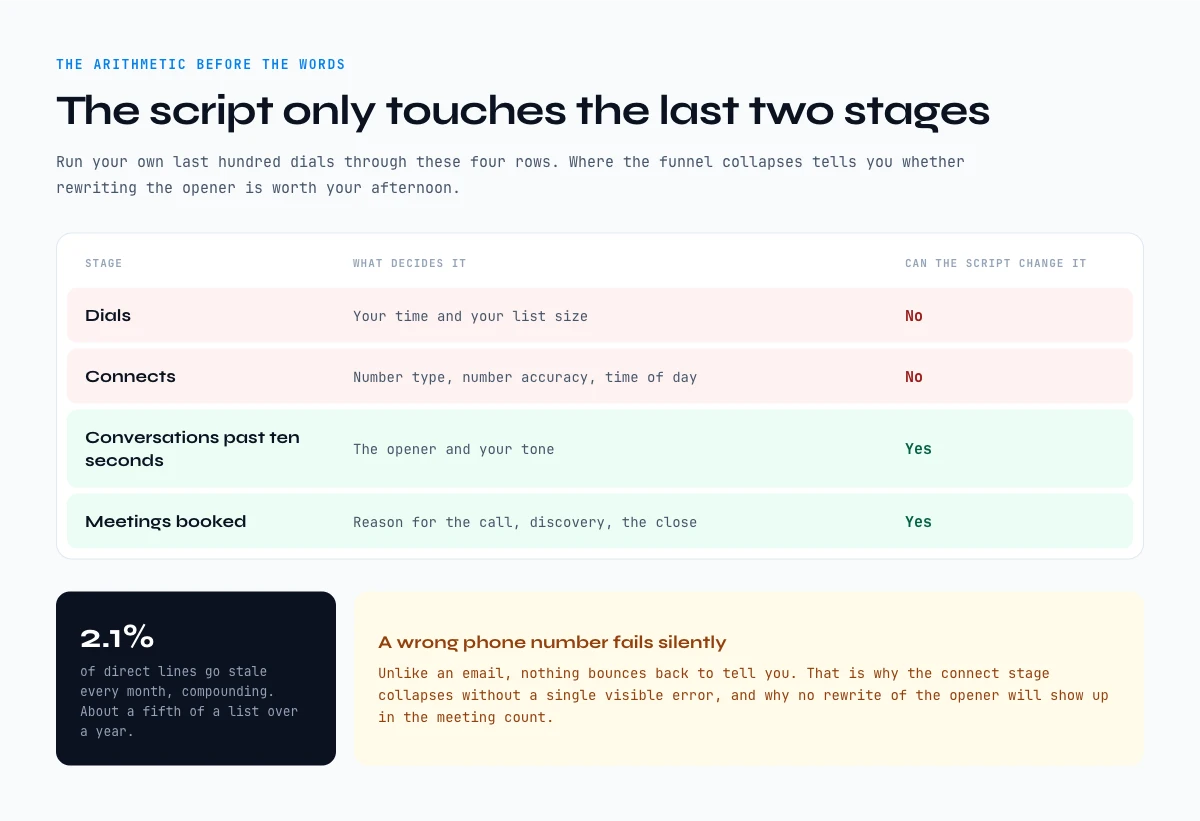
Write the funnel out before you write the words. A calling session has four stages, and the script only touches the last two.
| Stage | What decides it | Can the script change it? |
|---|---|---|
| Dials | Your time and your list size | No |
| Connects | Number type, number accuracy, time of day | No |
| Conversations past ten seconds | The opener and your tone | Yes |
| Meetings booked | Reason for the call, discovery, the close | Yes |
Run your own last hundred dials through those four rows. If your connect rate is where the funnel collapses, the script is not your bottleneck and rewriting it will not move the meeting count. If you connect fine and the conversation dies at ten seconds, the opener is the problem and this page is worth your afternoon.
Two numbers explain why the connect stage fails as often as it does. Direct lines go stale at roughly 2.1 percent a month, compounding, which quietly removes about a fifth of a list over a year without a single visible error. And a wrong phone number fails silently: unlike an email, nothing bounces back to tell you. We put the full picture together in the state of B2B phone data, where Gartner's estimate of 12.9 million dollars a year as the average cost of poor data quality sits next to Validity's finding that 76 percent of teams believe less than half their CRM is accurate.
The four columns that decide whether your call connects
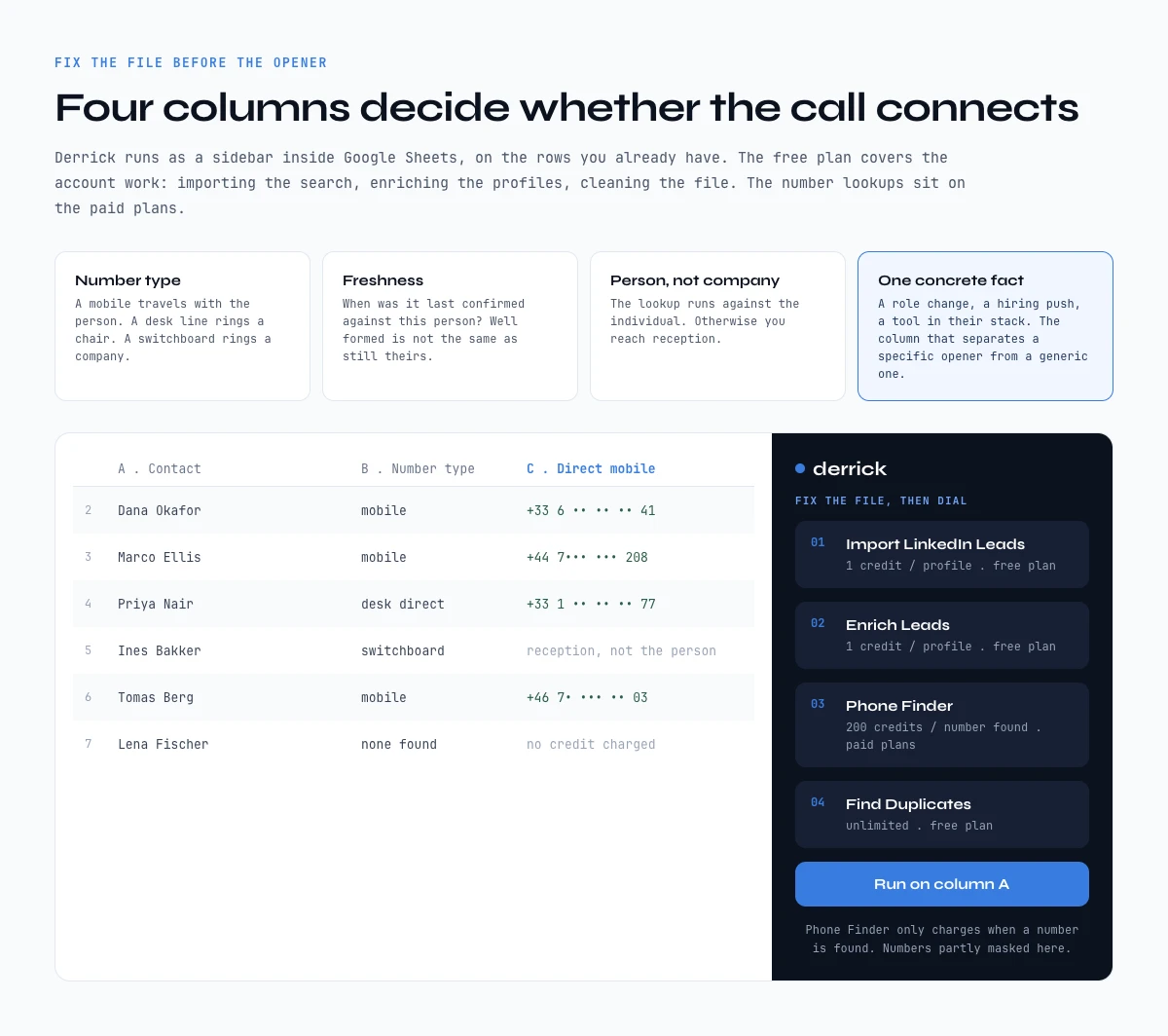
Before the script, fix the file. Four columns do most of the work.
- Number type. A mobile travels with the person. A desk direct dial rings a chair. A switchboard rings a company. Since hybrid work emptied the desks, the gap between those three has widened enough that it now predicts your connect rate better than total coverage does. We laid out the evidence in mobile versus landline in B2B.
- Freshness. When was this number last confirmed against this person? A number pulled from a two-year-old export is a guess with a plausible format. Phone number validation tells you the number is well formed and routable, which is not the same as telling you it is still theirs.
- Person, not company. You are calling a human being, so the lookup has to run against the individual rather than the organisation. That is the difference between reaching a named decision-maker and reaching reception.
- One concrete fact about them. Not a personality read. A fact: a recent role change, a hiring push, a product launch, a tool in their stack. This is the raw material for the reason-for-the-call block, and it is the single column that separates a specific opener from a generic one.
How to write your own B2B cold call script in 6 steps
Six steps, one per block, written in this order. Each block has a job, a length, and a failure mode. If your question is simply how to cold call for B2B, this is the short answer: get these six blocks right, then fix the list behind them.
Block 1: the opener (five seconds)
Say your first name, your company, and then stop talking. The instinct is to fill the pause with credentials. Do not. The pause is what signals that this is a conversation rather than a recording, and the answer you get back tells you which script branch you are on. Failure mode: stacking three sentences before the other person has said a word.
Block 2: permission (five seconds)
Name the fact that you have interrupted them, and ask for a short, specific amount of time. Thirty seconds is a real request. "Do you have a few minutes" is not, because nobody knows what they are agreeing to. Failure mode: asking a question so soft it invites a no, such as "is now a bad time".
Block 3: the reason for the call (fifteen seconds)
This is where the fact column pays for itself. Give the specific reason you are calling this person rather than anyone else with their job title, then connect it to a problem you can describe in their words, not yours. Failure mode: describing your product. Nobody has agreed to hear about your product yet.
Block 4: discovery (two to four questions)
Ask about the current process before you ask about the pain. "How are you handling X at the moment" is answerable. "What are your biggest challenges around X" asks a stranger to do your qualification work while standing in a corridor. Two questions is usually enough on a first call. Failure mode: interrogation.
Block 5: objection handling (as needed)
Covered in full below. The rule for all of them: acknowledge, then ask one question. Never argue.
Block 6: the close (ten seconds)
Propose one specific slot, not a general willingness to meet. "Does Thursday at two work, or is Friday morning easier" gives a person two decisions instead of an open calendar. Failure mode: ending with "I will send you some information", which is where calls go to die.
In the web app or Google Sheets
The data behind the six blocks
Each block of the script needs one fact about the person: their role, their company, where they are. Derrick fills those columns on the call list, so the script is read off the row instead of improvised on the line.
- Feature
- LinkedIn Leads Profile Enrichment
- Credit cost
- 1 credit per lead enriched
The first button opens the web app (nothing to install): 1 credit per lead enriched, 100 free credits every month. The second details the feature and its cost per plan.
A full B2B cold call script you can read out loud
Read this one aloud once, then rewrite it in your own words. A script that sounds like someone else talking is worse than no script at all.
You: "Hi, this is Marie from Derrick." (stop)
Them: "Uh, hi?"
You: "I know I've caught you out of the blue. Can I have thirty seconds to explain why I called, and you can tell me if it's worth continuing?"
Them: "Go ahead."
You: "I saw you opened two SDR roles last month. Usually when a team doubles its calling capacity, the list stops keeping up before the headcount does, and reps end up dialling numbers that ring nowhere. How are you sourcing numbers for the new hires at the moment?"
Them: (answers, or objects)
You: "That makes sense. And when a number turns out to be wrong, how do you find out, is it just the rep noticing?"
Them: (answers)
You: "That's the part I'd want to show you, it takes about fifteen minutes. Does Thursday at two work, or is Friday morning easier?"
Notice the shape. Nine lines. One fact about them, one problem stated in their terms, two questions, one specific slot. Everything else has been cut, and that is the point: length is what makes a script sound scripted.
B2B cold calling scripts for 7 situations
The full call above covers the common case: you reach the decision-maker directly. These seven cold calling scripts cover what happens around it. Each one keeps the six blocks and changes what goes into them. Copy them, swap the parts in brackets, then say them in your own words. They are words only. For delivery, pace and practice habits, see our guide to cold calling techniques.
1. The gatekeeper script
When to use it: you dial a switchboard, or an assistant picks up the direct line.
You: "Hi, this is [first name, last name] from [company]. I'm trying to reach [prospect] about how your sales team gets its phone numbers. Is that still [him / her], or does someone else own it now?"
Them: "What's it regarding?"
You: "Fair question. I work with sales teams that are adding reps, and I'd like ten minutes with [prospect] to see if it's relevant. Could you put me through, or tell me when [he / she] is easiest to catch?"
If it's a no: "No problem. Who should I speak to instead, and would it be better if I emailed first?"
The habits behind it, mostly being direct and skipping the tricks, are in the gatekeepers section further down.
2. The voicemail script
When to use it: attempts one and two, when nobody picks up. Keep it under twenty seconds.
You: "Hi [prospect], [first name] from [company]. I'm calling because you opened two SDR roles last month and I had one idea about how the new reps get their numbers. I'll try you again Thursday morning. If that's easier, my number is [number], again, [number]. Thanks."
Two details carry it. You say when you'll call back, and you say the number twice, slowly.
3. The follow-up call script
When to use it: you had a first conversation, sent something, and now need the next step.
You: "Hi [prospect], it's [first name] from [company]. We spoke on Tuesday about the numbers your new reps are dialling. Is now still okay for two minutes?"
Them: "Sure."
You: "Last time you said the reps find wrong numbers on their own. Did you get a chance to look at how many came back wrong last week?"
Them: (answers)
You: "Then the useful next step is fifteen minutes on your current list, together. Wednesday at ten or Thursday at three?"
Open on what they told you, not on what you sent them. Nobody remembers the attachment.
4. The referral script
When to use it: someone inside the account pointed you to this person.
You: "Hi [prospect], this is [first name] from [company]. [Colleague's name] on your sales team suggested I call you. Do you have thirty seconds?"
Them: "Okay."
You: "[Colleague] said you own the tooling for the outbound team, so the question of where the phone numbers come from lands with you. How are you handling that today?"
Name the colleague in the first sentence and say why they sent you. "Someone on your team" throws away the only advantage you have.
5. The trigger or signal-based script
When to use it: something changed at the account in the last few weeks. A funding round, a hiring push, a new person in the seat.
You: "Hi [prospect], [first name] from [company]. I saw you joined as Head of Sales in August, congratulations. Thirty seconds on why I called?"
Them: "Go ahead."
You: "People who've just taken over a sales team usually review the list and the tools in their first ninety days. Where are you on that, and is the phone data part of it?"
The signal has to be true and recent. An event from last year reads like a template, because it is one.
6. The appointment setting script
When to use it: the only goal of the call is the meeting, often for an account executive who will run it.
You: "Hi [prospect], [first name] from [company]. I'll be quick: I'm calling to set up a short meeting, not to pitch you on the phone. Is that okay?"
Them: "What's the meeting about?"
You: "My colleague [name] works with sales teams of five to twenty reps on how they get direct numbers. [He / she] would take twenty minutes to show what that looks like on your list. Tuesday at eleven or Wednesday at four?"
Them: (picks one)
You: "Tuesday at eleven, then. I'm sending the invite to this address now, and [name] will lead it."
Repeat the slot out loud before you hang up. If you can, send the invite while they're still on the line.
7. Cold calling script for software sales
When to use it: you sell software to a team that has already heard your category pitch.
You: "Hi [prospect], [first name] from [company]." (stop) "I know this is out of the blue. Thirty seconds, then you tell me if it's worth continuing?"
Them: "Sure."
You: "You run outbound with six reps. At that size, what I keep seeing is reps losing their first hour on finding numbers instead of calling. How does that hour go for your team?"
Them: (answers)
You: "And when a number turns out to be wrong, how do you find out?"
Them: (answers)
You: "That's what I'd like to show you, it takes about fifteen minutes. Thursday at two, or Friday morning?"
Name a consequence, the lost hour, not a feature. The variants section below shows block 3 alone for this situation.
How many cold calling scripts do you need?
Three to start: the full call, the voicemail and the gatekeeper. Add the follow-up and referral scripts once you have calls to follow up on. Past five, nobody on the team remembers which one to use, and that defeats the point of having a script.
What script should an SDR use?
An SDR booking meetings for someone else should start from the appointment setting script, because the job of the call is the slot, not the discovery. Keep the full six block call for the conversations that open up. And log which script ran on each call, so you can compare them later.
The app works through your list row by row: 1 credit per lead enriched.
Adapting your B2B cold call script by industry
The six blocks don't change from one industry to the next. What changes is the person you ask for and the fact you open block 3 with. Software sales has its own script above, so it's left out here.
| Industry | Who to ask for | The fact for block 3 | Watch out for |
|---|---|---|---|
| Professional services (accounting, consulting, law) | Partner or practice lead | A new office, a new partner, a new service line | Partners bill their time. Ask for twenty seconds, not thirty. |
| Manufacturing | Plant manager, operations or purchasing lead | A new site, a new production line, a job posting on the floor | Many decision-makers work away from a desk phone, so a mobile number matters more here. |
| Agencies | Founder or head of growth | A new client announced, a new hire, a new service | Small teams, so the founder often picks up. Keep the permission block very short. |
| Logistics and transport | Operations or fleet manager | A new warehouse, a new route, a hiring push for drivers | A call during a shift change goes nowhere. Ask the gatekeeper when the shift ends. |
If your market isn't in the table, keep the method: one person to ask for, one recent fact, one thing to avoid.
B2B cold call script variants for four openings
The six blocks stay. Block 3 changes with the reason you are calling.
| Opening | What block 3 becomes | Where the fact comes from |
|---|---|---|
| Hiring signal | They opened roles that imply the problem you solve | Job postings on the company page |
| New in role | They took the job in the last ninety days and are still choosing tools | Role change date on the profile |
| Tech stack | They run a tool yours sits next to or replaces | Website technology detection |
| Referral inside the account | A colleague pointed you to them, named explicitly | The previous call in the same account |
The referral opening is the one that tends to earn the most patience, and it is the one most teams never build a habit around. Every call you make inside an account should end with a question about who else owns the problem, whether or not the call went well.
Software sales: block 3 only
Software buyers have heard your category pitch already, so block 3 has to name a consequence rather than a capability. This is the short form. The complete software sales call, from opener to close, is in the seven situations above.
You: "Hi, this is Marie from Derrick." (stop) "I know this is out of the blue. Thirty seconds, then you can tell me to go away?"
Them: "Go on."
You: "You run outbound on a team of six. The pattern I keep seeing at that size is that reps burn their first hour of the day chasing numbers instead of dialling. How does that hour actually go for your team right now?"
A cold call script for a recruitment desk
Recruiters are called constantly, so the permission block has to be shorter and the reason has to be a candidate or a role, never a platform.
You: "Hi, Marie from Derrick, twenty seconds?" (pause) "You have three engineering roles open in Lyon. Most desks I speak to can source the profiles fine and then lose two days finding a way to actually reach them. Is that where it slows down for you, or somewhere else?"
Same six blocks in all three. Only the content of block 3 moved, which is the whole point of separating structure from wording.
Handling the five objections you will actually hear
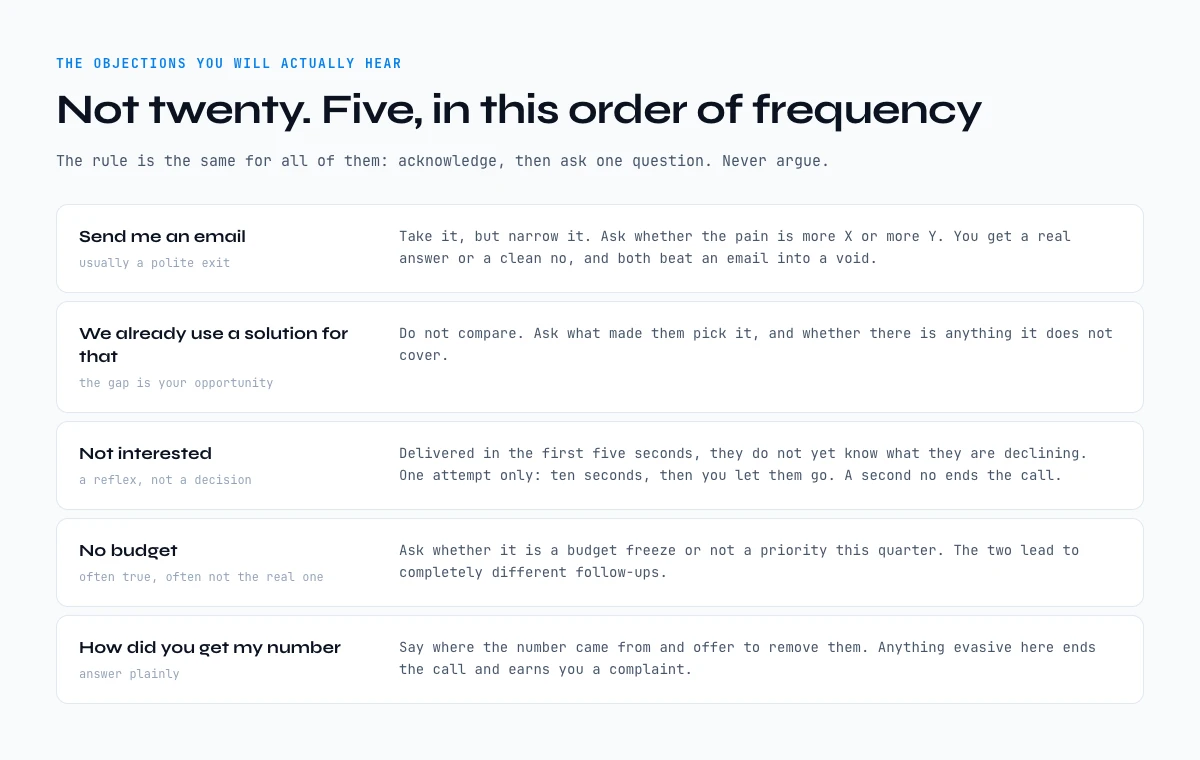
Not twenty. Five, in this order of frequency.
- "Send me an email." Usually a polite exit. Take it, but narrow it: "Happy to. So that I send you something useful instead of a brochure, is the pain more X or more Y?" You either get a real answer or a clean no, and both beat an email into a void. If you go the email route, send it to an address you have actually verified rather than a guessed pattern, which is what the Email Finder is for at 5 credits per email found.
- "We already use a solution for that." Do not compare. Ask: "Makes sense, most teams your size do. What made you pick it, and is there anything it doesn't cover?" The gap is your entire opportunity.
- "Not interested." Delivered in the first five seconds, this is a reflex, not a decision, because they do not yet know what they are declining. One attempt only: "Fair enough, most people say that before they know why I'm calling. Ten seconds, then I'll let you go?" If it is a second no, thank them and hang up.
- "No budget." Often true and often not the real objection. "Understood. Is it a budget freeze, or is it not a priority this quarter?" The two lead to completely different follow-ups.
- "How did you get my number?" Answer plainly and without embarrassment. Say where the number came from and offer to remove them. Anything evasive here ends the call and earns you a complaint.
Gatekeepers, voicemail, and the second dial
A gatekeeper is doing their job well, so treat them as a person with information rather than an obstacle. Be direct, give your first and last name, name the person you are calling, and say plainly why. Tricks are transparent and they get logged. If the answer is a firm no, ask the one question worth asking: "Is there a better time, or is someone else handling this now?"
For voicemail, twenty seconds is the ceiling. Name, company, one sentence on why you called, your number said slowly, then stop. Do not pitch. The point of a voicemail is not a call back, which is rare, it is that your name is familiar when you dial again three days later.
That second dial is where most of the value sits, and where most teams quit. If you reach someone on attempt four, everything you learned on attempts one to three is what made the call warm.
When to call, and how many attempts
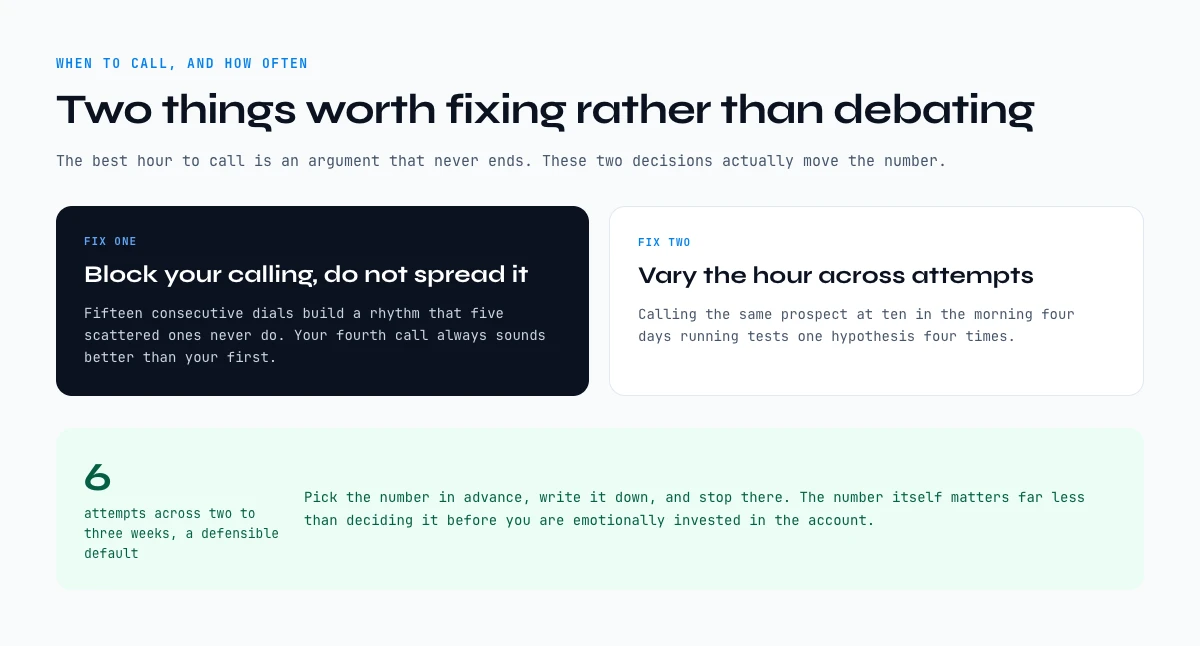
Two things are worth fixing rather than debating. First, block your calling instead of spreading it: fifteen consecutive dials build a rhythm that five scattered ones never do, and your fourth call always sounds better than your first. Second, vary the hour across attempts on the same person. Calling the same prospect at ten in the morning four days running tests one hypothesis four times.
On persistence, pick a number of attempts in advance, write it down, and stop there. Six is a defensible default across two to three weeks. The number matters far less than deciding it before you are emotionally invested in the account.
Compliance before you dial
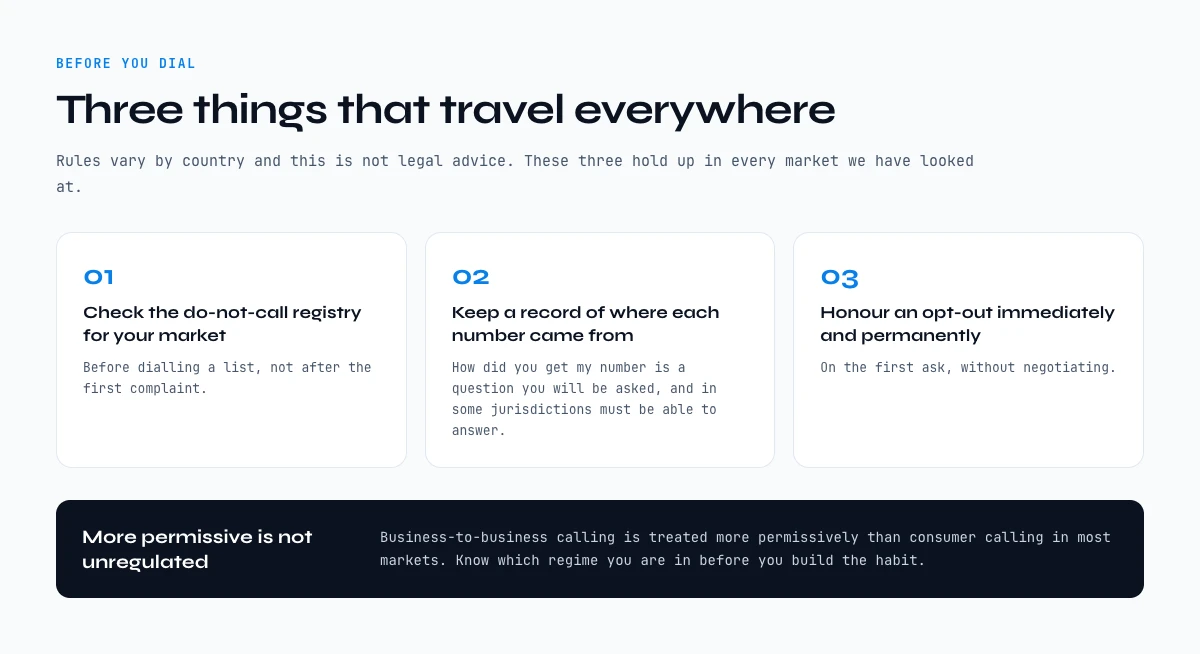
Is B2B cold calling illegal? It depends on the country, which is why this section sticks to the three rules that hold everywhere.
Rules vary by country and this is not legal advice, but three things travel everywhere. Check the do-not-call registry that applies to your market before dialling a list. Keep a record of where each number came from, because "how did you get my number" is a question you will be asked and, in some jurisdictions, must be able to answer. And honour an opt-out immediately and permanently, on the first ask, without negotiating.
Business-to-business calling is treated more permissively than consumer calling in most markets, which is not the same as being unregulated. Know which regime you are in before you build the habit.
How to test a B2B cold call script without guessing
Change one block at a time. If you rewrite the opener and the reason for the call in the same week, a change in meetings tells you nothing about which one moved it.
Measure at the stage you are trying to move. An opener is judged on the share of connects that last past ten seconds, not on meetings booked, because meetings are downstream of four other things. A close is judged on meetings per conversation. A list change is judged on connect rate alone.
And give it enough volume. As a working rule of thumb rather than a statistical threshold, treat fifty connects as a direction and a hundred as something you can act on. Twelve calls on a Tuesday afternoon tells you about your afternoon. Before you conclude that your script is broken, confirm that enough people actually heard it.
If the connect rate is the number holding you back, that is a file problem with a file fix: pull mobiles against the individuals you plan to call, on the day you plan to call them. The Phone Finder does that from the web app or the Sheets sidebar at 200 credits per phone number found, billed only when a number actually comes back, and Search Leads resolves the right person at each account first at 1 credit per profile. Both sit on the paid plans, and both work the same way on forty rows and on forty thousand.
Once the numbers are right, come back to the six blocks. That is the order that works, and it is the reverse of the order most teams try. If you are still assembling the list itself, start from the guide to finding B2B phone numbers and come back here when the file is ready.
Frequently asked questions
What should a B2B cold call script contain?
How long should a cold call script be?
Why is my cold call script not booking meetings?
Should you read a cold call script word for word?
How do you get past a gatekeeper on a cold call?
How many times should you call the same prospect?
What do you say on a cold call voicemail?
What is the best cold call script for B2B?
Keep reading
Continue exploring this cluster


Mobile vs Landline in B2B 2026: Why the Desk Phone Stopped Working
Read →

The State of B2B Phone Data 2026: Decay, the Mobile Shift & What It Costs
Read →

How to Find B2B Phone Numbers: 7 Verified Methods + Tools (2026)
Read →

Phone Number Lookup from LinkedIn: How to Find Phone Numbers in 2026
Read →